Achieving a perfectly aligned table saw fence is crucial for safe and accurate woodworking, preventing issues like burn marks, imprecise cuts, and dangerous kickback. This alignment ensures the workpiece remains parallel to the saw blade throughout the cut, a fundamental requirement for quality craftsmanship. Every home DIYer can master this skill by following a methodical approach and using the right tools, leading to consistent, accurate, and safe cuts every time.
The Critical Role of Your Table Saw Fence
The table saw fence is the primary guide for rip cuts, ensuring the workpiece stays parallel to the saw blade. This precise parallelism is essential for uniform cut width and preventing problems. An out-of-alignment fence can cause wood to bind against the blade, leading to excessive friction, burn marks, and strain on the motor. More critically, binding significantly increases the risk of kickback, a violent and hazardous ejection of the workpiece that can cause serious injury. Even a slight deviation of a few thousandths of an inch can compromise project integrity and safety. Therefore, maintaining fence alignment is paramount for precision woodworking and a secure workshop environment.
Understanding Common Table Saw Fence Types and Adjustment Points
Table saw fences vary in design, each with unique locking and adjustment mechanisms. While the core alignment principle remains consistent, knowing your fence type helps locate specific adjustment points. For see our table saws recommendations on this site.
T-Square Fences
The T-square fence is a common type found on many contractor, hybrid, and cabinet saws. Its design features a “T” shaped head that clamps onto a front rail, often with a three-point locking system for stability. These fences are valued for rigidity and ease of use. Adjustment screws, typically in the fence head where it engages the front rail, allow for pivoting the fence to achieve parallelism with the blade.
Rail-Mounted & Aftermarket Fences
Some table saws, especially older models or specific designs, use fences that slide along both front and rear rails. Aftermarket fence systems from brands like Biesemeyer (now Delta Machinery), Vega, and Incra are popular upgrades, offering enhanced stability, improved locking mechanisms, and sometimes micro-adjusters for fine-tuned settings. Adjustment points vary but generally involve set screws or bolts that allow the fence to be squared to the table and then pivoted parallel to the blade. All reliable fences include provisions for fine-tuning their alignment.
Essential Tools for Precision Alignment
Achieving a perfectly aligned table saw fence requires a systematic approach and the right tools. While basic checks can be done with minimal equipment, precision tools provide the accuracy needed for flawless cuts.
- Combination Square: An indispensable tool for quick checks against the miter slot and fence to identify obvious misalignment.
- Measuring Tape: Necessary for initial checks from the blade to the fence, though its accuracy is limited for fine adjustments.
- Dial Indicator: For ultimate precision, a dial indicator mounted on a miter bar or custom sled measures minute deviations (down to thousandths of an inch) across the fence length, allowing for incredibly accurate adjustments.
- Straightedge: A high-quality, known-straight metal straightedge checks the straightness of the fence face and can gauge parallelism.
- Wrenches/Hex Keys: Essential for loosening and tightening adjustment screws on your specific fence system. Consult your saw’s manual for correct sizes.
- Scrap Wood/Miter Slot Blanks: A flat piece of scrap wood, or a UHMW (Ultra High Molecular Weight) polyethylene plastic strip cut to fit snugly in your miter slot, serves as an excellent reference point for checking parallelism or creating DIY alignment jigs.
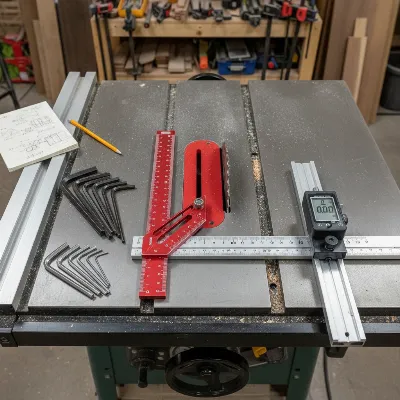 Essential tools for aligning a table saw fence, including a combination square, dial indicator, and wrenches.
Step-by-Step Guide to Achieving Perfect Fence Alignment
Aligning your table saw fence is a process that requires patience and precision, but following these steps will lead to excellent results.
Safety First: Preparation is Key
|
Our Picks for the Best Table Saw in 2026
As an Amazon Associate I earn from qualifying purchases.
|
||
| Num | Product | Action |
|---|---|---|
| 1 | Woodworking table saw, can be installed in the operating table, 25kg saw blade can be adjusted up and down 55X36X40 cm |

|
| 2 | PROXXON Table Saw FET for Precision Cuts in Wood, Non-Ferrous Metals, Plastics - Adjustable Blade, Extendable Table, Low Noise Motor, 110-120V AC - 37070 |
|
| 3 | POWERTEC Portable Small Workbench with Vise, Imprinted Ruler and Protractor Scale, Folding Sawhorse/Worktable and 4 Bench Dogs for Woodworking Projects (MT4006V) |
|
| 4 | Skil 3550-02 7-Inch Wet Tile Saw with HydroLock Water Containment System |
|
| 5 | SKIL 3601-02 Flooring Saw with 36T Contractor Blade, Red and black |
|
| 6 | VEVOR Band Saw, 9-Inch, Woodworking Benchtop Bandsaw with 1/2 HP Motor, 3.5-Inch Max Cutting Height, 11.8 x 11.8 in Cast Aluminum Table, 0-45° Tilting Range, with Miter Gauge, Fence, for Woodworking |
|
| 7 | Lapidary Rock Saw for Cutting Rocks, 750W Mini Lapidary Equipment for Jewelry and Gemstone Polishing, 110V Table Saw Grinder Machine with Polishing Kit for Jade Agate Wood and Beeswax |
|
| 8 | POWERTEC Push Block and Push Stick Set Fits Table Saws, Router Tables, Band Saws & Jointers, Dual Ergonomic Handles w/Max Grip, Wood Pusher Reduces Kickback & Increases Safety. 5PK (71009V) |
|
| 9 | SKIL 7-Inch Wet Tile Saw - 3540-02 |
|
| 10 | 4" 60W MINI ELECTRIC TABLE SAW BENCH TOP GREAT ELECTRIC HOBBY CRAFT TABLE SAW DIY Power Tool Work Bench Stand Circular 2 PIECES Blades |
|
Before attempting any adjustments, always prioritize safety. Unplug your table saw from the power source. This prevents accidental startups while your hands are near the blade. Raise your saw blade to its highest possible position and remove any blade guards or splitter/riving knife if they obstruct access. Clean the saw table, miter slots, and the fence face thoroughly to remove sawdust, resin, or debris that could interfere with accurate measurements.
Pre-Alignment Check: Blade Parallelism to Miter Slot
This is a critical prerequisite. Your fence can only be truly parallel to the blade if the blade itself is parallel to the miter slot. Most table saw manufacturers provide instructions for checking and adjusting blade-to-miter-slot parallelism in your owner’s manual. This usually involves measuring from a specific blade tooth to the miter slot at the front and back of the blade. Ensure this alignment is within tolerance (typically a few thousandths of an inch) before proceeding with fence alignment.
Initial Fence Check: The “Finger” or “Square” Method
For a quick, preliminary check, try the “finger” method. Place your finger on the sidewall of a miter slot closest to the fence. Slide the fence over until its face is flush with your finger. Now, keeping your finger pressed against the slot, slide it along to the back edge of the saw, checking if the fence remains flush. If it deviates, your fence is out of alignment. Alternatively, place a combination square in your miter slot, pressed against the edge. Lock your fence next to the ruler and slide the square along the track. Any gaps or pressure changes indicate misalignment.
Precision Measurement: Blade-to-Fence Parallelism
For a more accurate assessment, use one of these methods:
- Marked Blade Tooth Method: Raise your blade fully. Select a single tooth and mark it with a marker. Rotate the blade so the marked tooth is at the front of the table. Lock your fence close to the blade and measure from the fence face to the marked tooth. Now, rotate the blade so the same marked tooth is at the back of the table and measure again. If the two measurements don’t match, your fence is out of parallel. Aim for identical measurements or a very slight toe-out.
- Dial Indicator Method: This offers the highest precision. Mount a dial indicator onto a miter bar or a custom sled that fits snugly in your miter slot. Position the indicator’s plunger against the front of your fence, zero it out, and then slide the assembly along the miter slot to the back of the fence. Any deviation displayed on the dial indicates misalignment. This method allows for reading exact thousandths of an inch differences.
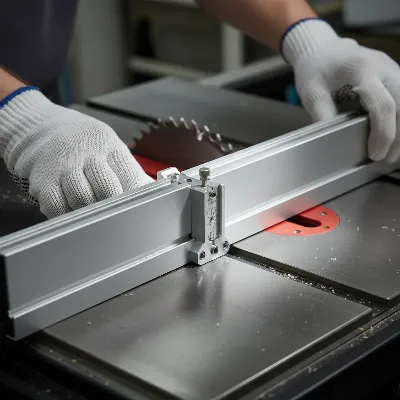 A close-up shot of a hand using a dial indicator mounted on a miter bar to check table saw fence alignment.
Making Adjustments: Fine-Tuning Your Fence
Once you’ve identified misalignment, it’s time to adjust. Most table saw fences have several set screws, typically located on the fence head or clamping mechanism, that allow for subtle pivoting. Consult your saw’s owner’s manual for the exact location and procedure for your specific model.
Generally, you’ll need to loosen a few locking nuts or screws, which then allow you to turn other adjustment screws to slightly pivot the fence. Make very small, incremental changes. A tiny turn of a screw can result in a significant shift at the back of the fence. Re-tighten the locking nuts and re-measure after each adjustment. Repeat until the fence is parallel.
- The “Toe-Out” Debate: While perfect parallelism is the technical goal, many experienced woodworkers prefer a very slight “toe-out,” meaning the back of the fence is infinitesimally further from the blade (perhaps by 0.001″ to 0.003″, or the thickness of a couple of sheets of paper) than the front. This slight outward angle helps prevent the workpiece from binding against the fence as it exits the cut, further reducing the risk of kickback and burn marks. Rockler suggests that a difference of less than 0.015″ to 0.020″ is perfectly acceptable.
Final Verification and Test Cuts
After making adjustments, perform the precision measurement again to confirm your fence is accurately aligned. Then, make a few test cuts on scrap wood. Observe the quality of the cut: Are there any burn marks? Is the cut edge smooth and straight? Measure the width of your test piece at both ends. If your cuts are clean, consistent, and accurate, your fence is perfectly aligned.
Troubleshooting Common Fence Alignment Problems
Even with careful alignment, issues can arise. Understanding common problems can help you diagnose and correct them quickly.
Persistent Misalignment & “Toe-In”
If your fence consistently shows “toe-in” (where the back of the fence is closer to the blade than the front), it’s a major safety concern. This condition is a primary cause of binding, burning, and dangerous kickback. Ensure you’re making incremental adjustments and re-measuring accurately. Double-check your owner’s manual for any specific quirks of your fence’s adjustment mechanism. Sometimes, underlying issues with the fence rails themselves or accumulated debris can prevent proper seating.
Fence Deflection & Inconsistent Cuts
If your cuts start perfectly but become inconsistent or curved towards the end, you might be experiencing fence deflection. This happens when you apply too much sideways pressure against the fence, causing it to flex slightly. To avoid this, use only gentle, consistent sideways pressure to keep the wood against the fence while focusing on pushing it forward and down onto the table. Also, ensure your fence’s locking mechanism is fully engaged and holding securely. A loose lock can allow the fence to shift during a cut.
Dealing with Blade Alignment Issues First
It cannot be stressed enough: your table saw blade must be parallel to the miter slot before you even attempt to align your fence. If your blade is out of alignment, no amount of fence adjustment will solve the problem. If you suspect your blade-to-miter-slot alignment is off, address that issue first using your saw’s manual or a dedicated blade alignment jig. Burn marks that occur along the entire length of a cut often point to blade misalignment, whereas marks at the end of a cut can indicate fence deflection.
Maintaining Your Table Saw Fence for Lasting Accuracy
Achieving perfect fence alignment isn’t a one-time task; it’s an ongoing commitment to safety and precision. Regular maintenance will ensure your fence remains true over time.
Regular Cleaning and Inspection
Make it a habit to clean your table saw and fence after each use. Sawdust and resin buildup on the fence face, rails, or locking mechanisms can impede smooth movement and cause inconsistent locking, leading to misalignment. Use a dry brush or compressed air to remove debris, and consider a specialized cleaner for resin buildup. Periodically inspect the fence for any damage, loose parts, or signs of wear that could affect its stability or accuracy.
Periodic Re-Checks
Even without obvious issues, vibrations from the saw, accidental bumps, or simply moving the saw around the shop can gradually knock your fence out of alignment. Develop a routine of checking your fence alignment before starting any significant project or periodically, perhaps once a month, depending on your usage. A quick check with a combination square or a marked blade tooth can save you hours of frustration and wasted material.
Best Practices for Use
Beyond mechanical adjustments, your technique during operation plays a crucial role in maintaining fence accuracy. Always apply gentle, consistent pressure to keep the workpiece against the fence without forcing it. Avoid heavy side pressure that can deflect the fence. Ensure your workpiece is flat and straight before cutting, as warped material can push against the fence unevenly. Using featherboards can provide additional stability, guiding the wood smoothly and consistently against the fence throughout the cut.
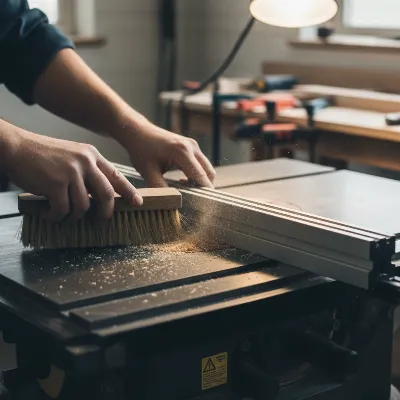 A person cleaning a table saw fence and table surface, emphasizing maintenance for accuracy.
Investing the time to perfectly align your table saw fence is one of the most impactful steps you can take to improve your woodworking projects. It transforms a potentially frustrating and dangerous tool into a precise instrument, capable of delivering the clean, accurate cuts that form the foundation of quality craftsmanship.
A perfectly aligned table saw fence is not a luxury but a fundamental necessity for safe and accurate woodworking. By understanding your fence’s mechanics, utilizing the right tools, and following a methodical alignment process, you can achieve professional-level precision in your home workshop. to prioritize safety, clean your equipment regularly, and re-check your alignment often to maintain consistent results. What’s the most challenging table saw alignment issue you’ve encountered, and how did you resolve it?

I’ve been struggling with burn marks on my longer rip cuts for ages, and I always just assumed it was my blade. Following these steps for fence alignment made a huge difference! My cuts are so much cleaner now, and I don’t have that annoying friction anymore. It’s amazing what a little precision can do for your woodworking.
This guide was super helpful for getting my old Craftsman table saw fence dialed in. I used to get some slight tapering on wider boards, which was really frustrating for cabinet making. After going through the methodical approach described, my cuts are consistently parallel. Wish I’d known about checking for parallelism sooner!
The instructions for preventing kickback were clear, and I appreciate the emphasis on safety. However, I found it a bit tricky to get the final micro-adjustments just right on my budget saw. It took me a few tries to get it perfect, and I still feel like my fence isn’t as solid as I’d like, even after alignment. Good info though.
Seriously, this is a game-changer. I was getting so frustrated with imprecise cuts on my projects, and I thought I needed a new saw. Turns out, my fence was just way off. Following the five steps, especially the part about checking the front and back of the fence, made my cuts flawless. No more wasted wood!