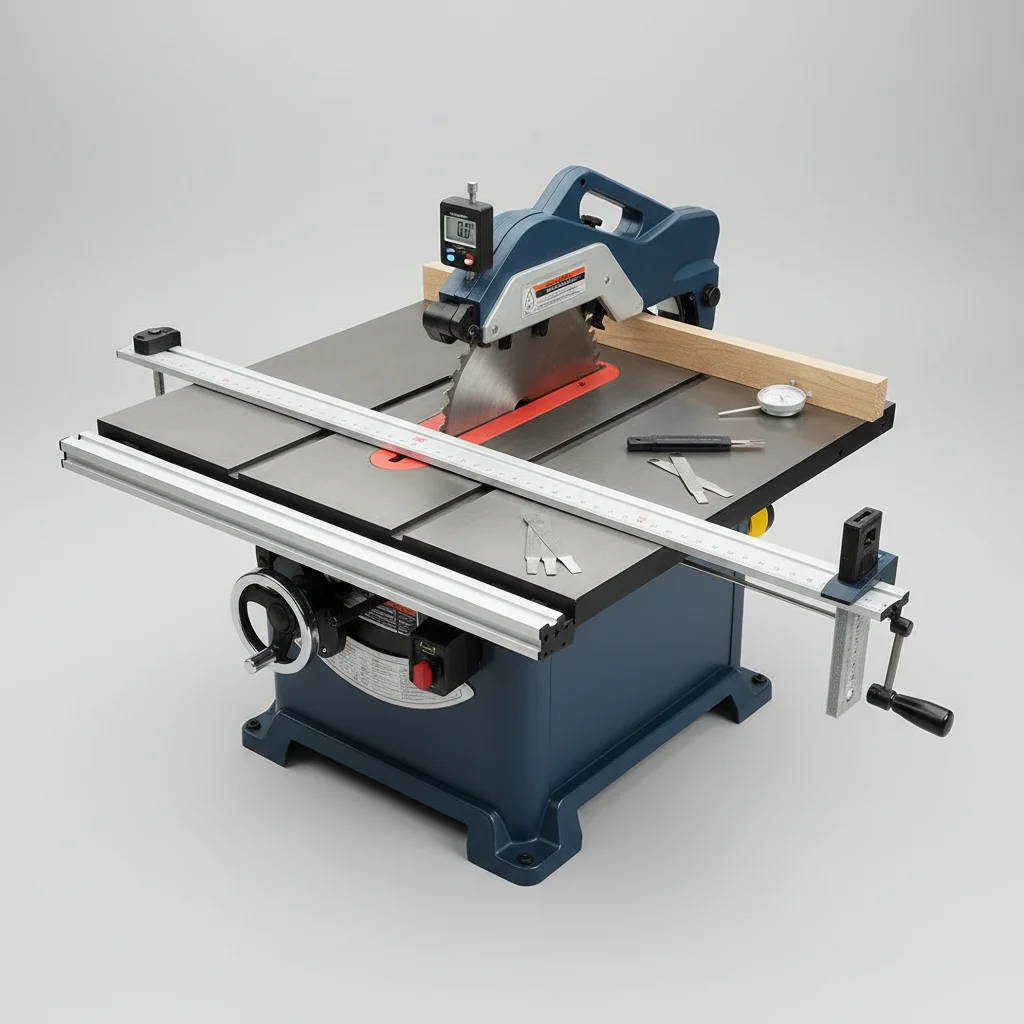
Achieving flawless cuts with your table saw hinges on precise alignment. There are five critical steps to ensure your table saw is perfectly calibrated for accuracy and safety. These steps involve checking and adjusting the blade, fence, miter gauge, and ultimately, the entire cutting path to eliminate errors and improve the quality of your woodworking projects.
Why Table Saw Alignment Matters for Every Project
Proper table saw alignment is not just about making pretty cuts; it’s fundamental for safety and efficiency. A misaligned blade can lead to dangerous kickback, inaccurate dimensions, and excessive wear on your saw and blades. Even a slight deviation can ruin expensive material and frustrate your efforts. Regular alignment checks ensure that every cut is predictable, clean, and safe, saving you time and money in the long run.
Step 1: Verify Blade Parallelism to the Miter Slot
The first and most crucial step is to ensure your table saw blade is perfectly parallel to the miter gauge slot. Use a dial indicator or a reliable straightedge to measure the distance from the miter slot to the blade at both the front and back of the blade. Any discrepancy indicates that the blade or the saw’s arbor assembly needs adjustment. Most saws allow for micro-adjustments to the trunnion assembly to achieve this parallelism.
Step 2: Align the Rip Fence to the Miter Slot and Blade
Once the blade is parallel to the miter slot, the next step is to align the rip fence. The fence must be parallel to both the miter slot and the blade. Clamp a straightedge into the miter slot and then bring the fence up to it, ensuring there’s no gap along its entire length. If adjustments are needed, most fences have set screws or bolts that allow for fine-tuning. A perfectly aligned fence prevents binding and ensures consistent cut widths.
- Check for parallelism at the front and back of the blade.
- Use a reliable straightedge or dial indicator.
- Adjust trunnion assembly if blade is not parallel.
- Ensure rip fence is parallel to both miter slot and blade.
- Tighten all locking mechanisms after adjustment.
Step 3: Calibrate the Miter Gauge for Accurate Angles
|
Our Picks for the Best Table Saw in 2026
As an Amazon Associate I earn from qualifying purchases.
|
||
| Num | Product | Action |
|---|---|---|
| 1 | Skil 3550-02 7-Inch Wet Tile Saw with HydroLock Water Containment System |

|
| 2 | SKIL 7-Inch Wet Tile Saw - 3540-02 |
|
| 3 | PROXXON Table Saw FET for Precision Cuts in Wood, Non-Ferrous Metals, Plastics - Adjustable Blade, Extendable Table, Low Noise Motor, 110-120V AC - 37070 |
|
| 4 | Woodworking table saw, can be installed in the operating table, 25kg saw blade can be adjusted up and down 55X36X40 cm |
|
| 5 | 4" 60W MINI ELECTRIC TABLE SAW BENCH TOP GREAT ELECTRIC HOBBY CRAFT TABLE SAW DIY Power Tool Work Bench Stand Circular 2 PIECES Blades |
|
| 6 | VEVOR Band Saw, 9-Inch, Woodworking Benchtop Bandsaw with 1/2 HP Motor, 3.5-Inch Max Cutting Height, 11.8 x 11.8 in Cast Aluminum Table, 0-45° Tilting Range, with Miter Gauge, Fence, for Woodworking |
|
| 7 | POWERTEC Push Block and Push Stick Set Fits Table Saws, Router Tables, Band Saws & Jointers, Dual Ergonomic Handles w/Max Grip, Wood Pusher Reduces Kickback & Increases Safety. 5PK (71009V) |
|
| 8 | POWERTEC Portable Small Workbench with Vise, Imprinted Ruler and Protractor Scale, Folding Sawhorse/Worktable and 4 Bench Dogs for Woodworking Projects (MT4006V) |
|
| 9 | SKIL 3601-02 Flooring Saw with 36T Contractor Blade, Red and black |
|
| 10 | Lapidary Rock Saw for Cutting Rocks, 750W Mini Lapidary Equipment for Jewelry and Gemstone Polishing, 110V Table Saw Grinder Machine with Polishing Kit for Jade Agate Wood and Beeswax |
|
The miter gauge is essential for precise crosscuts and angled cuts. To calibrate it, use a reliable machinist’s square or a digital angle finder to set it to exactly 90 degrees relative to the blade. Make a test cut on a scrap piece of wood, then flip one of the cut pieces and butt it against the other to check for a perfect 180-degree angle. Adjust the miter gauge’s stop screw until it consistently produces accurate 90-degree cuts.
Step 4: Check Blade Perpendicularity to the Table Surface
For accurate depth of cut and square edges, the blade must be perfectly perpendicular to the table surface when set at 90 degrees. Use a precision square to check this. Raise the blade to its maximum height and place the square against the blade and the table. If there’s a gap, adjust the saw’s blade tilt mechanism until the blade is perfectly square. This ensures that your dado cuts and rabbets are clean and precise.
Step 5: Fine-Tune the Zero-Clearance Insert
A zero-clearance insert significantly reduces tear-out and supports small workpieces. While not directly an alignment of the saw’s core components, ensuring your zero-clearance insert is flush with the table surface is the final touch for optimal performance. Any proud or recessed edges can snag material or affect cut quality. Use shims or the insert’s leveling screws to achieve a perfectly flush surface.

I always struggled with tear-out on my crosscuts, and I never really thought about how much the blade’s parallelism to the miter slot affected it. Following Step 1 made a huge difference! My cuts are so much cleaner now, and it’s made my DIY furniture projects look way more professional. Definitely a game-changer for accuracy.
I appreciate the focus on safety and efficiency, which is so important with table saws. I tried to follow the steps for checking the entire cutting path, but my miter gauge seems a bit off no matter what I do. It’s probably just my older model, but it was a bit frustrating. Still, good reminders on why regular checks are crucial.
I used to get so frustrated with kickback, and I just assumed it was part of using a table saw. After reading about how a misaligned blade can cause it, I went through all five steps. My saw feels so much safer now, and the cuts are incredibly precise. This saved me a lot of headaches and potentially ruined material.
This guide was super helpful for getting my old Craftsman saw dialed in. I’d been putting off adjusting the fence because it seemed complicated, but the instructions here made it straightforward. My only minor complaint is that I wish there were a few more pictures for each step, but I still managed to get it done. No more slightly tapered rips!