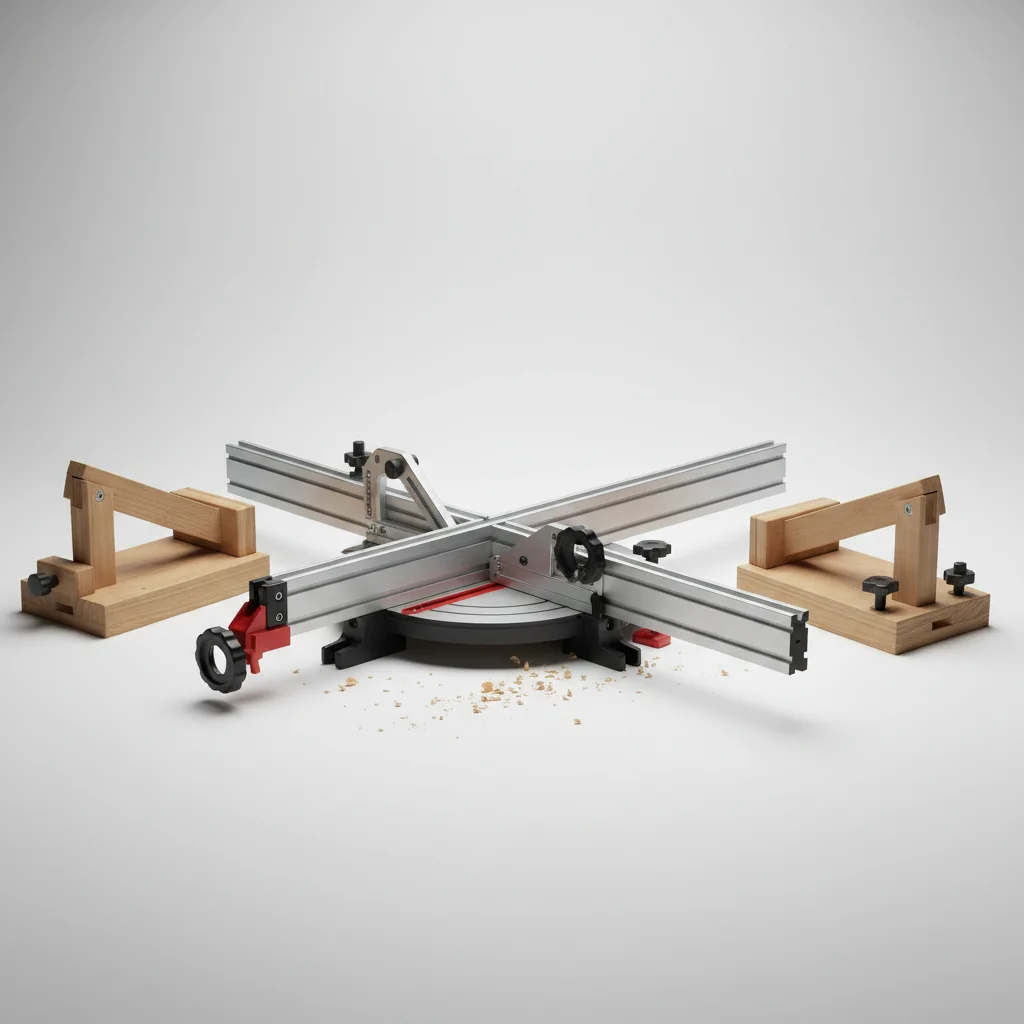
Table saw crosscut sleds are indispensable tools for achieving precise and repeatable angled cuts on your table saw. While many table saws come with a basic miter gauge, a dedicated crosscut sled offers significantly enhanced stability, accuracy, and safety, especially for wider workpieces or complex angles. There are typically three main types of crosscut sleds: basic single-runner sleds, advanced double-runner sleds, and specialized sleds for specific tasks like tenons or box joints. Each type offers distinct advantages depending on your woodworking needs and the level of precision required for your projects.
Why Upgrade to a Crosscut Sled?
A standard miter gauge, while functional for basic crosscuts, often lacks the stability and support needed for truly accurate and safe cuts on a table saw. Crosscut sleds, by contrast, provide a large, flat surface that supports the workpiece fully, preventing it from shifting during the cut. This full support is crucial for minimizing tear-out and ensuring square or precisely angled cuts. Furthermore, a well-designed sled often incorporates features like hold-downs and stop blocks, which further enhance safety and repeatability, making it easier to produce identical pieces for projects like cabinetry or picture frames.
Types of Table Saw Crosscut Sleds
The most common type is the single-runner sled, which uses one miter slot for guidance. These are relatively simple to build or purchase and are excellent for general crosscutting. Double-runner sleds, utilizing both miter slots, offer superior stability and are often preferred for larger workpieces or when extreme precision is paramount. Specialized sleds, such as those designed for cutting tenons or creating box joints, are tailored for specific joinery tasks, providing jigs and fences that simplify complex cuts. Choosing the right type depends on the complexity and scale of your woodworking projects.
- Single-runner sleds: Best for general crosscutting and smaller shops.
- Double-runner sleds: Offer maximum stability for large panels and high precision.
- Tenon jigs: Specifically designed for cutting tenons accurately and safely.
- Box joint jigs: Simplifies the creation of strong and decorative box joints.
- Panel-cutting sleds: Ideal for safely and accurately cutting large sheet goods.
Building vs. Buying a Crosscut Sled
|
Our Picks for the Best Table Saw in 2026
As an Amazon Associate I earn from qualifying purchases.
|
||
| Num | Product | Action |
|---|---|---|
| 1 | POWERTEC Push Block and Push Stick Set Fits Table Saws, Router Tables, Band Saws & Jointers, Dual Ergonomic Handles w/Max Grip, Wood Pusher Reduces Kickback & Increases Safety. 5PK (71009V) |

|
| 2 | SKIL 7-Inch Wet Tile Saw - 3540-02 |
|
| 3 | 4" 60W MINI ELECTRIC TABLE SAW BENCH TOP GREAT ELECTRIC HOBBY CRAFT TABLE SAW DIY Power Tool Work Bench Stand Circular 2 PIECES Blades |
|
| 4 | Lapidary Rock Saw for Cutting Rocks, 750W Mini Lapidary Equipment for Jewelry and Gemstone Polishing, 110V Table Saw Grinder Machine with Polishing Kit for Jade Agate Wood and Beeswax |
|
| 5 | PROXXON Table Saw FET for Precision Cuts in Wood, Non-Ferrous Metals, Plastics - Adjustable Blade, Extendable Table, Low Noise Motor, 110-120V AC - 37070 |
|
| 6 | POWERTEC Portable Small Workbench with Vise, Imprinted Ruler and Protractor Scale, Folding Sawhorse/Worktable and 4 Bench Dogs for Woodworking Projects (MT4006V) |
|
| 7 | SKIL 3601-02 Flooring Saw with 36T Contractor Blade, Red and black |
|
| 8 | Woodworking table saw, can be installed in the operating table, 25kg saw blade can be adjusted up and down 55X36X40 cm |
|
| 9 | VEVOR Band Saw, 9-Inch, Woodworking Benchtop Bandsaw with 1/2 HP Motor, 3.5-Inch Max Cutting Height, 11.8 x 11.8 in Cast Aluminum Table, 0-45° Tilting Range, with Miter Gauge, Fence, for Woodworking |
|
| 10 | Skil 3550-02 7-Inch Wet Tile Saw with HydroLock Water Containment System |
|
Many woodworkers opt to build their own crosscut sleds, as it allows for customization to their specific table saw and project needs. Building a sled can be a rewarding project in itself, offering a deeper understanding of its mechanics and ensuring a perfect fit. However, for those who prefer a ready-made solution or require advanced features, there are many excellent commercial crosscut sleds available. These often come with pre-calibrated fences, micro-adjustments, and durable construction. Consider your skill level, time availability, and budget when deciding whether to build or buy. For a reliable pre-built option, consider the, known for its robust construction and precise adjustments.
Essential Features for a Quality Sled
When selecting or designing a crosscut sled, several features are crucial for optimal performance. A sturdy fence that is perfectly square to the blade (or precisely angled) is paramount. The runners should fit snugly in your table saw’s miter slots without binding or excessive play. Adjustable stop blocks are invaluable for repeatable cuts, and integrated hold-downs can significantly improve safety by securing the workpiece. Some advanced sleds also include micro-adjustment mechanisms for fine-tuning angles, which is particularly useful for joinery. Ensure the sled’s base is flat and made from a stable material like Baltic birch plywood or MDF to prevent warping over time.
Safety and Maintenance Tips
Using a crosscut sled significantly enhances safety compared to freehand cutting or using a flimsy miter gauge. Always ensure the sled is properly seated in the miter slots before making a cut. Keep your hands clear of the blade path and utilize push blocks or hold-downs to secure the workpiece. Regularly check the sled’s fence for squareness and adjust as needed, especially after heavy use or if you notice any inaccuracies in your cuts. Keep the runners clean and free of sawdust to ensure smooth operation. For an excellent all-around choice that balances features and value, theis highly recommended by many users.

My old miter gauge was just not cutting it for the precision I needed on my furniture builds. Getting a proper crosscut sled has made such a difference. The full support for the workpiece means no more wobbles or inaccurate angles. It’s definitely an essential tool if you want professional-looking results.
I finally invested in a double-runner crosscut sled after struggling with my miter gauge for too long. The difference in stability is night and day, especially when I’m working with wider panels for cabinet doors. My angled cuts are now perfectly repeatable, which has saved me so much time and material. This is a game-changer for anyone serious about woodworking.
I got one of the specialized sleds for tenons, and while it does a decent job, I found the setup to be a bit finicky. It takes a while to get it perfectly dialed in for each cut, which can be frustrating when you’re in a hurry. Once it’s set, the cuts are good, but I wish it was a bit more user-friendly out of the box.
I built a basic single-runner sled a few months ago, and it’s been a huge improvement for my DIY projects. It’s so much safer than trying to balance larger pieces on the miter gauge. I’m thinking about upgrading to a more advanced one soon to tackle some complex box joints, but for now, this has really upped my accuracy.