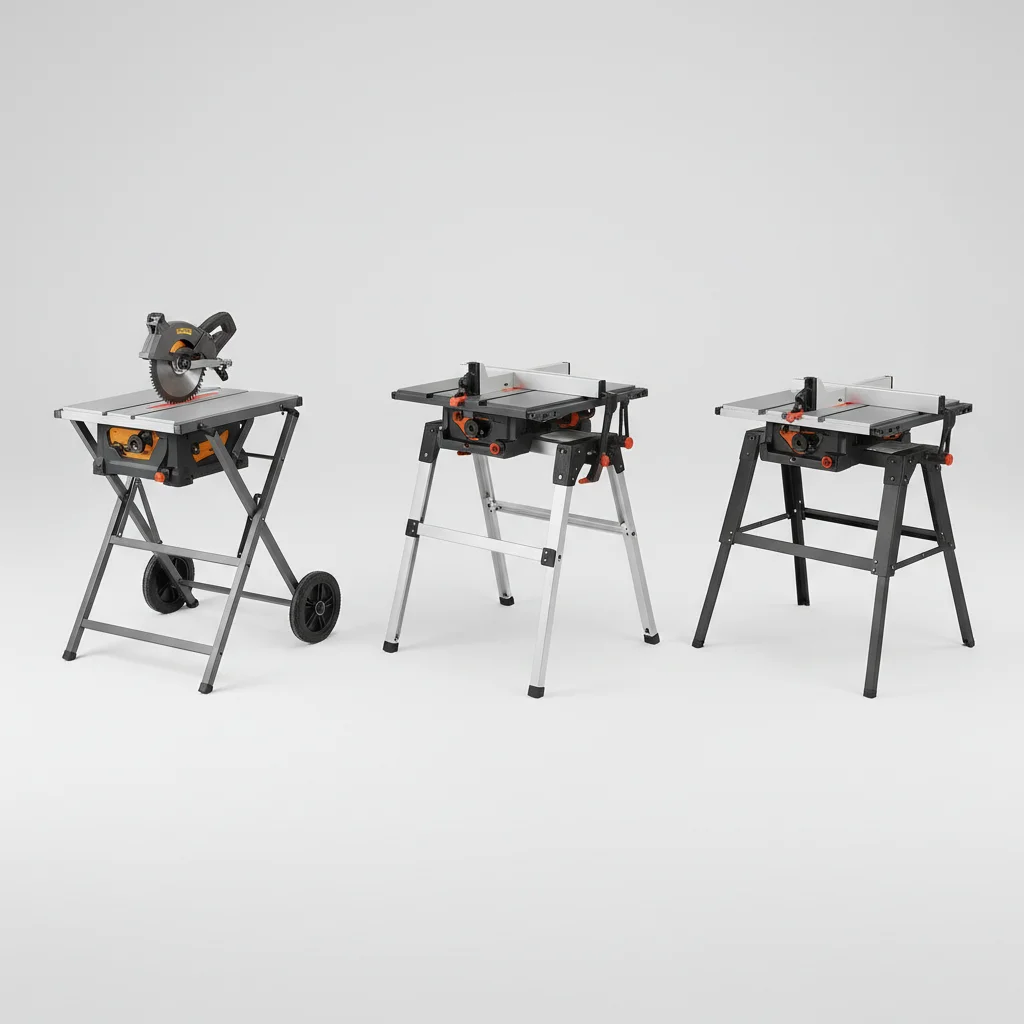
Choosing the right table saw stand is crucial for both stability and safety in your workshop. There are primarily four main types of table saw stands available, each offering distinct advantages depending on your workspace, budget, and portability needs. Understanding these differences will help you select the best option to ensure your table saw operates securely and efficiently, preventing wobbles and improving cut accuracy.
Understanding the Different Types of Table Saw Stands
Table saw stands come in various designs, each catering to specific user requirements. The most common types include stationary, portable (folding), rolling, and custom-built stands. Stationary stands are typically heavy-duty, providing maximum stability for dedicated workshop spaces. Portable stands, often with folding legs, are ideal for job sites or small shops where space is at a premium. Rolling stands combine portability with stability, featuring wheels for easy movement around the shop. Custom-built stands offer the ultimate in personalization, allowing woodworkers to design a stand that perfectly fits their saw and workflow.
Stationary Stands: Unmatched Stability for Dedicated Shops
Stationary table saw stands are designed for permanent placement in a workshop. They are often constructed from heavy-gauge steel or cast iron, providing a solid, unmoving base for your table saw. This type of stand minimizes vibration and offers superior stability, which is essential for precise cuts and safe operation, especially when working with large or heavy materials. While they lack portability, their robust construction ensures a long lifespan and consistent performance. Many professional woodworkers prefer stationary stands for their reliability and the ability to integrate them into a larger workshop system.
Portable (Folding) Stands: Flexibility for On-the-Go Projects
Portable or folding table saw stands are a popular choice for contractors, DIY enthusiasts, and anyone with limited workshop space. These stands feature collapsible legs or frames, allowing them to be easily folded up and transported. Despite their portability, many modern portable stands are surprisingly sturdy, often incorporating quick-release mechanisms for easy setup and breakdown. They are particularly useful for job site work where the saw needs to be moved frequently. While they may not offer the same rock-solid stability as a stationary stand, their convenience often outweighs this minor trade-off for users who prioritize mobility.
- Lightweight and easy to transport
- Quick setup and breakdown
- Ideal for job sites and small spaces
- Often includes integrated storage or accessory mounts
- Can be stored compactly when not in use
Rolling Stands: The Best of Both Worlds
|
Our Picks for the Best Table Saw in 2026
As an Amazon Associate I earn from qualifying purchases.
|
||
| Num | Product | Action |
|---|---|---|
| 1 | PROXXON Table Saw FET for Precision Cuts in Wood, Non-Ferrous Metals, Plastics - Adjustable Blade, Extendable Table, Low Noise Motor, 110-120V AC - 37070 |

|
| 2 | SKIL 3601-02 Flooring Saw with 36T Contractor Blade, Red and black |
|
| 3 | Lapidary Rock Saw for Cutting Rocks, 750W Mini Lapidary Equipment for Jewelry and Gemstone Polishing, 110V Table Saw Grinder Machine with Polishing Kit for Jade Agate Wood and Beeswax |
|
| 4 | SKIL 7-Inch Wet Tile Saw - 3540-02 |
|
| 5 | Skil 3550-02 7-Inch Wet Tile Saw with HydroLock Water Containment System |
|
| 6 | Woodworking table saw, can be installed in the operating table, 25kg saw blade can be adjusted up and down 55X36X40 cm |
|
| 7 | 4" 60W MINI ELECTRIC TABLE SAW BENCH TOP GREAT ELECTRIC HOBBY CRAFT TABLE SAW DIY Power Tool Work Bench Stand Circular 2 PIECES Blades |
|
| 8 | POWERTEC Push Block and Push Stick Set Fits Table Saws, Router Tables, Band Saws & Jointers, Dual Ergonomic Handles w/Max Grip, Wood Pusher Reduces Kickback & Increases Safety. 5PK (71009V) |
|
| 9 | VEVOR Band Saw, 9-Inch, Woodworking Benchtop Bandsaw with 1/2 HP Motor, 3.5-Inch Max Cutting Height, 11.8 x 11.8 in Cast Aluminum Table, 0-45° Tilting Range, with Miter Gauge, Fence, for Woodworking |
|
| 10 | POWERTEC Portable Small Workbench with Vise, Imprinted Ruler and Protractor Scale, Folding Sawhorse/Worktable and 4 Bench Dogs for Woodworking Projects (MT4006V) |
|
Rolling table saw stands offer a compelling balance between stability and mobility. These stands are equipped with wheels, allowing you to easily move your table saw around the workshop without lifting it. Once in position, many rolling stands feature locking casters or leveling feet to secure the saw in place, providing a stable work platform. This design is perfect for workshops that need to reconfigure their layout frequently or for users who want the convenience of moving their saw closer to materials or power outlets. They are generally more robust than basic portable stands but still offer significant flexibility compared to stationary models.
Custom-Built Stands: Tailored to Your Specific Needs
For the ultimate in customization and integration, a custom-built table saw stand is an excellent option. Woodworkers can design and construct a stand that perfectly matches their specific table saw model, incorporates desired storage solutions, and fits seamlessly into their workshop layout. Custom stands can include features like integrated outfeed tables, dust collection ports, and specialized storage for blades and accessories. While requiring more time and skill to create, a custom stand can significantly enhance workflow and efficiency, providing a truly personalized and optimized workspace. Materials can range from sturdy plywood to steel, depending on the desired durability and aesthetic.
Choosing the Right Stand for Your Workshop
When deciding on the best table saw stand, consider your primary use case, available space, and budget. If you have a dedicated workshop and prioritize maximum stability for precision work, a stationary stand is likely your best bet. For those who need to move their saw frequently or have limited space, a portable or rolling stand offers the necessary flexibility. If you’re an experienced woodworker looking for a highly integrated and personalized solution, a custom-built stand might be the ideal choice. Each type of stand has its merits, and the ‘best’ one ultimately depends on your individual needs and how you plan to use your table saw.
