For woodworking enthusiasts and DIYers, the best budget table saws under $300 in 2026 include the SKIL 10-Inch Table Saw (TS6307-00), the HERCULES 15 Amp 10 In. Compact Jobsite Table Saw, and the Goplus 10″ Table Saw. These models offer a balance of power, essential safety features, and decent accuracy for their price point, making them suitable for various home and job site projects without a significant investment.
Table Saw: Overview and Applications
A table saw is an indispensable tool in any woodworking shop or on a job site, prized for its ability to make precise, repeatable cuts. Unlike handheld tools such as circular saws or jigsaws, a table saw’s fixed blade protruding through a flat table surface allows for consistent and accurate ripping, crosscutting, and beveling of various materials. Its robust design provides stability, which is paramount for achieving clean and straight edges.
Primarily, table saws are used for tasks requiring high accuracy, such as cutting large panels, creating trim, building cabinets, and sizing lumber for furniture. They are versatile tools that can be adapted for different cuts by simply changing the blade, making them a cornerstone for projects ranging from intricate joinery to general construction and DIY home improvements. For expert table saws reviews on this site.
Classifying Table Saws and Selection Criteria
When exploring table saws, especially within a tighter budget, you’ll primarily encounter benchtop and portable/jobsite models. Understanding their distinctions is crucial for choosing the right tool for your needs.
Benchtop Table Saws
Benchtop table saws are the smallest and most compact type, designed to be placed on an existing workbench or a separate, non-integrated stand. Their primary advantages include their portability and space-saving design, making them ideal for small workshops or garages where floor space is limited. They often come with removable stands, offering flexibility in setup. However, they typically feature smaller tables and may have less powerful motors compared to their larger counterparts, which can limit their rip capacity for very wide materials. These saws are perfect for hobbyists, DIYers, and those who need a tool that can be easily stored or moved.
Portable/Jobsite Table Saws
Portable, often referred to as jobsite table saws, are designed with mobility in mind, featuring integrated folding stands or wheeled carts for easy transport between locations. They strike a balance between power and portability, often equipped with 15-amp motors capable of handling common cutting tasks on various materials. While generally more robust than benchtop models, their stability might still be less than a stationary cabinet saw. These saws are highly favored by contractors who need to move their tools frequently and serious DIYers looking for a versatile and powerful mobile solution for their projects.
Detailed Comparison Table for Budget Table Saws
Navigating the budget table saw market requires a close look at specifications and features. Here’s a comparison of some popular models often found under or around the $300 mark, highlighting their key attributes for you to consider.
| Model | Motor Power (Amps) | Speed (RPM) | Blade Size | Rip Capacity (Max Right) | Weight (lbs) | Key Features | Warranty |
|---|---|---|---|---|---|---|---|
| SKIL 10-Inch Table Saw (TS6307-00) | 15 | 5,000 | 10″ | 25.5″ | 51.15 | Folding Stand, Rack-and-Pinion Fence, EZ View Measurement, On-board Storage | 3-5 years |
| HERCULES 15 Amp 10 In. Compact Jobsite Saw | 15 | N/A | 10″ | 24.5″ | 53 | Rack-and-Pinion Fence, On-board Storage (No stand included) | Short |
| Goplus 10″ Table Saw | 15 | 4,800 | 10″ | 26″ (extendable) | 57 | Extendable Cast Aluminum Table, 1.5” Dust Port, Push Stick & Guard | 2 years |
| WORX WX572L BladeRunner x2 Portable Saw | 15 | 5,000 | 10″ | N/A (tabletop) | 50 | Highly Portable, Safety Key Ignition, Sheer Tablet Top | 1 year |
Buying Guide: How to Choose a Budget Table Saw
Choosing the best budget table saw involves more than just looking at the price tag. It’s about finding a tool that aligns with your projects and provides reliable performance without compromising safety.
Determine Your Usage Needs
|
Our Picks for the Best Table Saw in 2026
As an Amazon Associate I earn from qualifying purchases.
|
||
| Num | Product | Action |
|---|---|---|
| 1 | SKIL 3601-02 Flooring Saw with 36T Contractor Blade, Red and black |

|
| 2 | 4" 60W MINI ELECTRIC TABLE SAW BENCH TOP GREAT ELECTRIC HOBBY CRAFT TABLE SAW DIY Power Tool Work Bench Stand Circular 2 PIECES Blades |
|
| 3 | POWERTEC Portable Small Workbench with Vise, Imprinted Ruler and Protractor Scale, Folding Sawhorse/Worktable and 4 Bench Dogs for Woodworking Projects (MT4006V) |
|
| 4 | PROXXON Table Saw FET for Precision Cuts in Wood, Non-Ferrous Metals, Plastics - Adjustable Blade, Extendable Table, Low Noise Motor, 110-120V AC - 37070 |
|
| 5 | Lapidary Rock Saw for Cutting Rocks, 750W Mini Lapidary Equipment for Jewelry and Gemstone Polishing, 110V Table Saw Grinder Machine with Polishing Kit for Jade Agate Wood and Beeswax |
|
| 6 | Woodworking table saw, can be installed in the operating table, 25kg saw blade can be adjusted up and down 55X36X40 cm |
|
| 7 | Skil 3550-02 7-Inch Wet Tile Saw with HydroLock Water Containment System |
|
| 8 | POWERTEC Push Block and Push Stick Set Fits Table Saws, Router Tables, Band Saws & Jointers, Dual Ergonomic Handles w/Max Grip, Wood Pusher Reduces Kickback & Increases Safety. 5PK (71009V) |
|
| 9 | VEVOR Band Saw, 9-Inch, Woodworking Benchtop Bandsaw with 1/2 HP Motor, 3.5-Inch Max Cutting Height, 11.8 x 11.8 in Cast Aluminum Table, 0-45° Tilting Range, with Miter Gauge, Fence, for Woodworking |
|
| 10 | SKIL 7-Inch Wet Tile Saw - 3540-02 |
|
Before making a purchase, ask yourself what kind of projects you’ll be tackling. Will you be cutting mostly softwoods for DIY furniture, or do you plan to work with hardwoods and plywood for cabinetry? Consider the frequency of use and the typical size of materials. If you’re building large shelving units, a greater rip capacity will be essential. For occasional small projects, a more compact saw might suffice.
Set a Realistic Budget
While we’re focusing on saws under $300, it’s important to have realistic expectations. At this price point, you can find portable, capable saws, but they may lack some of the advanced features, extensive rip capacity, or long-term durability of professional-grade models. Prioritize core functionality and safety over excessive bells and whistles.
Key Technical Specifications
Understanding key specifications will help you make an informed decision:
- Motor Power: Most budget table saws come with a 15-amp motor, which is generally sufficient for ripping through common lumber and sheet goods. While some high-end saws are rated in horsepower, for this category, amperage is the standard measure.
- Blade Size: A 10-inch blade is the most common and versatile size for table saws, capable of handling most woodworking tasks and providing a good balance between cutting depth and availability of replacement blades.
- Rip Capacity: This refers to the maximum width of material you can cut between the blade and the fence. For general DIY and smaller projects, a rip capacity of 20-25 inches is often adequate. If you plan to break down full sheets of plywood, you might need something closer to 30 inches, which can be challenging to find under $300.
- Speed (RPM): A higher RPM (revolutions per minute) generally translates to cleaner cuts, especially in dense materials. Look for saws with at least 4,500 RPM for effective performance.
Essential Safety Features
Table saws are powerful tools that demand respect. Prioritizing safety features is non-negotiable, regardless of your budget. Look for:
- Riving Knife or Splitter: This thin piece of metal sits behind the blade and helps prevent kickback by keeping the kerf (the cut slot) open.
- Blade Guard: A transparent cover that shields the spinning blade, protecting you from accidental contact and flying debris.
- Anti-Kickback Pawls: Toothed devices that engage the workpiece to prevent it from being thrown back towards the operator.
- Accessible Emergency Stop Button: Allows for quick shutdown in case of an emergency.
Brand Reputation and User Reviews
Investigate brands known for producing reliable power tools, even in their budget lines. SKIL, DeWalt (for their more compact models), and sometimes Hercules or Goplus can offer good value. Always check recent user reviews for consistent feedback on accuracy, ease of use, and any common issues. Positive reviews often highlight features like a precise rack-and-pinion fence system, which is crucial for accurate cuts. “I’d say the fence is the most important thing to consider, whatever your budget is. But for those on a tighter budget, I would recommend choosing a table saw with a rack and pinion fence for a more reliable alignment.”
Top Budget Table Saws Under $300 in 2026
While the sub-$300 category doesn’t offer professional-grade tools, several models stand out for their exceptional value, performance, and features.
SKIL 10-Inch Table Saw with Folding Stand (Model TS6307-00)
Often cited as a top budget choice, the SKIL TS6307-00 offers an impressive array of features for its price point. It boasts a 15-amp motor with a 5,000 RPM no-load speed, capable of handling a variety of cutting tasks. Its integrated folding stand provides portability and stability, a significant advantage for job site use or compact storage. The saw typically offers a 25.5-inch rip capacity and features a rack-and-pinion fence system, which is highly valued for its precision and ease of adjustment. Reviewers often praise its accuracy for an entry-level saw. However, some users note its heavier weight (around 51-67 pounds) compared to other portable options and its loudness during operation. It also includes an EZ View measurement system and a self-aligning rip fence, further enhancing accuracy.
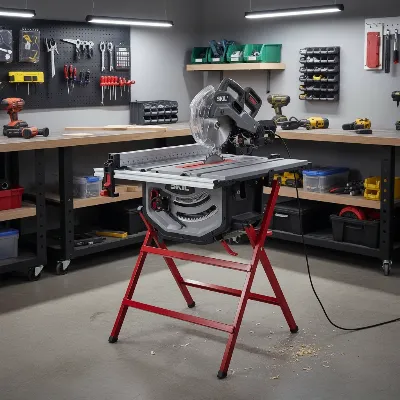 A close-up of the SKIL 10-inch table saw (TS6307-00) with its folding stand, ready for use in a garage workshop.
HERCULES 15 Amp 10 In. Compact Jobsite Table Saw
The HERCULES Compact Jobsite Table Saw is a strong contender in the budget category, often lauded for delivering solid performance at an economical price. Equipped with a 15-amp motor and a 10-inch blade, it offers a respectable 24.5-inch rip capacity, suitable for most home improvement projects. Its rack-and-pinion fence system contributes to straight and accurate cuts right out of the box. While it doesn’t come with an integrated stand, it features bench mounting holes for versatile setup options. Users appreciate its portability and included on-board storage. However, some find the extended fence finicky and the assembly instructions can be challenging to follow. The warranty period is also noted to be shorter than some competitors.
Goplus 10″ Table Saw
The Goplus 10″ Table Saw stands out for its powerful 15-amp motor, delivering 4,800 RPM, and an extendable cast aluminum table that can expand from 23.6×21.6 inches to a generous 40×20 inches. This extendable table is a significant advantage for handling larger workpieces, a rare feature in this price range. It offers a 3 ⅛-inch cut height and includes a 1.5-inch dust port for better chip management, along with a push stick and blade guard for safe operation. The durable metal roll cage design helps reduce vibrations, enhancing cutting accuracy. However, some reviews suggest that cutting accuracy might be compromised on longer cuts, making it better suited for smaller projects where precision isn’t paramount over extended lengths. It typically comes with a 2-year warranty.
WORX WX572L BladeRunner x2 Portable Tabletop Saw
For those seeking an extremely portable and versatile option for very light-duty tasks, the WORX WX572L BladeRunner x2 might be worth considering. While it’s more of a portable tabletop saw than a traditional table saw, it features a 15-amp motor with 5,000 RPM, impressive for its size. Its key strengths are its high portability and safety features like a safety key ignition. It excels at smaller, shorter cuts but may struggle with accuracy and experience binding on longer materials. This model is often found well under $200, making it an accessible entry point for beginners or those with very occasional, small-scale needs.
Table Saw Safety: Your Top Priority
Working with a table saw requires a deep understanding and strict adherence to safety protocols. Even budget-friendly models are powerful machines that can cause serious injury if not handled correctly.
Personal Protective Equipment (PPE)
Always wear appropriate personal protective equipment. This includes safety glasses to protect against flying debris, hearing protection (earplugs or earmuffs) to guard against noise-induced hearing loss, and a dust mask to prevent inhalation of fine sawdust. Avoid loose clothing, jewelry, and tie back long hair that could get caught in moving parts. While operating the saw, avoid wearing gloves as they can snag and pull your hand into the blade.
Pre-Operation Checks
Before every use, perform a thorough inspection of your table saw. Ensure the blade is clean, sharp, and properly installed. Verify that the rip fence is correctly aligned and locked securely. Check that the riving knife, blade guard, and anti-kickback pawls are in place and functioning. Clear your workspace of any clutter, scraps, or potential tripping hazards, and ensure adequate lighting. A clean work area minimizes distractions and risks.
Fundamental Cutting Techniques
Always use proper cutting techniques. When making rip cuts (cutting with the grain), use the rip fence to guide your material. For crosscuts (cutting across the grain), use a miter gauge or a crosscut sled. Never attempt freehand cuts. Always use a push stick or push block to feed the workpiece through the blade, especially for the last few inches, keeping your hands safely away from the blade. Maintain a firm grip on the material and a consistent feed rate.
What Not to Do
Several actions significantly increase the risk of injury and must be strictly avoided. Never reach over or behind the spinning blade. Do not remove or disable safety guards, even for seemingly simple cuts. Avoid forcing a cut, as this can lead to kickback, where the workpiece is violently thrown back towards you. Never use the rip fence and the miter gauge simultaneously for a cut, as this can also cause kickback. If you need to make a non-through cut (like a dado or groove), ensure your saw is equipped for it and follow specific safety guidelines.
“A table saw is a workhorse, but it demands your full attention and respect. Cutting corners on safety is simply not an option, no matter how small the project or tight the budget.” – Admin, ReviewsArray.com
Conclusion
Finding a capable table saw for under $300 is entirely possible for hobbyists, DIYers, and those with lighter professional needs. While you won’t get all the premium features of higher-end models, the SKIL 10-Inch Table Saw (TS6307-00), HERCULES 15 Amp 10 In. Compact Jobsite Table Saw, and Goplus 10″ Table Saw offer excellent value, combining adequate power, decent accuracy, and essential safety features for the price. The SKIL TS6307-00, with its rack-and-pinion fence and folding stand, often emerges as a top pick for its overall balance of features and performance.
Remember to prioritize your specific project needs, pay close attention to critical specifications like rip capacity and motor power, and above all, never compromise on safety. By making an informed decision, you can equip your workshop with a reliable table saw that will serve you well for many woodworking adventures to come. Which budget-friendly table saw features are most important to you for your upcoming projects?
Frequently Asked Questions
What is the difference between a benchtop and a portable jobsite table saw?
Benchtop table saws are typically smaller and lighter, designed to sit on a separate workbench, making them ideal for portability and small spaces. Portable jobsite table saws are generally more robust, often include integrated folding stands or wheels for easy transport, and offer a good balance of power and mobility for contractors.
Can a budget table saw handle hardwoods effectively?
Yes, most budget table saws equipped with a 15-amp motor and a sharp 10-inch blade can handle hardwoods for typical cuts. However, users may need to feed the material slower to prevent bogging down the motor or burning the wood, especially with very thick or dense hardwoods.
How important is the fence system on a table saw for accurate cuts?
The fence system is one of the most critical components for accuracy on any table saw. A good fence, particularly a rack-and-pinion type, ensures it remains parallel to the blade throughout its range, leading to straight and consistent rip cuts. A flimsy or misaligned fence will result in inaccurate and potentially dangerous cuts.
What are the most crucial safety features for a beginner using a table saw?
For beginners, a riving knife (or splitter), a blade guard, and anti-kickback pawls are paramount to prevent kickback and accidental blade contact. An easily accessible emergency stop button is also vital. Learning to properly use push sticks and maintaining a clear workspace are equally important safety habits.
What maintenance is typically required for a budget table saw?
Regular maintenance for a budget table saw includes keeping the blade clean and sharp, clearing sawdust from the motor and table mechanisms, checking the fence for alignment, and lubricating moving parts as recommended by the manufacturer. Proper maintenance ensures longevity, optimal performance, and safety.
How to Choose a Budget Table Saw
Choosing the best budget table saw involves evaluating your usage needs, setting a realistic budget, understanding key technical specifications, and prioritizing essential safety features.
Before purchasing, consider the types of projects you'll undertake, such as cutting softwoods for furniture or hardwoods for cabinetry. Evaluate the frequency of use and typical material sizes; for large shelving units, a greater rip capacity is essential, while smaller projects might suffice with a compact saw.
For saws under $300, expect portable, capable tools, but understand they may lack advanced features or the long-term durability of professional models. Prioritize core functionality and safety over excessive bells and whistles to find the best value.
Focus on motor power (most budget saws have a 15-amp motor), blade size (10-inch is common), rip capacity (20-25 inches for DIY, 30 inches for plywood), and speed (at least 4,500 RPM for clean cuts). These specs directly impact the saw's performance for your projects.
Always look for a riving knife or splitter, a blade guard, anti-kickback pawls, and an accessible emergency stop button. These features are non-negotiable for preventing kickback and accidental contact, ensuring safe operation regardless of budget.
Research brands known for reliable power tools like SKIL, DeWalt, Hercules, or Goplus, even in their budget lines. Read recent user reviews for consistent feedback on accuracy, ease of use, and common issues, paying close attention to comments on the fence system's precision.

The Goplus 10″ Table Saw has been a great addition to my DIY arsenal. I mostly use it for smaller projects around the house, like cutting trim and shelving, and it handles those tasks perfectly. The safety features are decent, which gives me peace of mind. For under $300, you really can’t go wrong with this one.
As a beginner woodworker, I was looking for something affordable yet capable, and the SKIL TS6307-00 has exceeded my expectations. It’s easy to set up and the accuracy for crosscutting has been impressive. I’ve been able to tackle several furniture projects with confidence, and it’s holding up great.
I got the HERCULES 15 Amp 10 In. Compact Jobsite Table Saw for some outdoor decking work. It’s powerful enough, but I found the fence to be a bit finicky to get perfectly square sometimes. It takes a little extra adjustment, which can slow things down. Still, for the price point, it gets the job done for most job site projects.
I picked up the SKIL 10-Inch Table Saw (TS6307-00) after reading about it here, and it’s been a game-changer for my garage workshop. The power is surprisingly good for the price, and I’ve been able to make really clean rip cuts on plywood for some new cabinets. It’s definitely a solid choice for anyone needing a reliable saw without breaking the bank.