For small woodworking shops, the best compact portable table saws balance robust performance with crucial mobility and a smaller footprint, allowing woodworkers to maximize space without compromising precision or power. These saws, primarily benchtop and contractor/jobsite models, are essential for tasks like ripping lumber, crosscutting panels, and creating dados, making them invaluable for DIY projects, furniture making, and trim carpentry where space is limited.
Table Saw: Overview and Applications
A table saw stands as the cornerstone of many woodworking shops, revered for its ability to make straight, accurate, and repeatable cuts. Its primary function involves a circular saw blade protruding through the surface of a table, allowing material to be fed into it against an adjustable fence. This design makes it indispensable for a wide array of tasks that other saws simply can’t match in precision or efficiency.
While there are several categories of table saws, including heavy-duty cabinet saws and versatile hybrid saws, the focus for small workshops is primarily on benchtop and contractor/jobsite models. These types prioritize portability and a more compact design without entirely sacrificing cutting power. They are essential for tasks like ripping lumber to width, crosscutting larger panels with a miter gauge or sled, cutting dados for joinery, and creating precise bevels. In small shops, these saws are invaluable for DIY projects, furniture making, trim carpentry, flooring installations, and general woodworking where space is a premium and the ability to move the saw or tuck it away is a significant advantage.
Classifying Portable Table Saws and Selection Criteria
Understanding the nuances between different types of portable table saws is crucial for making an informed decision for your small shop. Each offers a unique balance of size, power, and features tailored to specific user needs.
Benchtop Table Saws
Benchtop table saws are the most compact and lightweight option available, designed to be placed directly on a workbench or a sturdy stand. Their primary advantage lies in their minimal footprint and ease of storage. They are typically equipped with 8-1/4 inch blades, though some may feature 10-inch blades, and are powered by direct-drive universal motors.
- Pros: Extremely portable, highly affordable, ideal for very small spaces or occasional use, easy to store when not in use.
- Cons: Generally less powerful than jobsite or contractor saws, limited rip capacity, can sometimes lack advanced features for precision or dust collection.
- Ideal User: Hobbyists, DIYers with limited budgets or space, those who need to frequently move their saw.
Contractor/Jobsite Table Saws
Contractor or jobsite table saws represent a step up in power and capability from benchtop models while retaining strong portability. Many come with integrated folding or rolling stands, making them easy to set up on a jobsite or maneuver around a small workshop. They typically feature 10-inch blades and more robust 15-amp motors, capable of handling tougher materials.
- Pros: Good balance of power and portability, often feature better rip capacity and more precise fence systems (like rack-and-pinion), suitable for regular use and demanding projects.
- Cons: Heavier and larger than benchtop models, can be more expensive, some stands can still be bulky even when folded.
- Ideal User: Serious hobbyists, small shop owners, general contractors, or those tackling larger, more frequent projects.
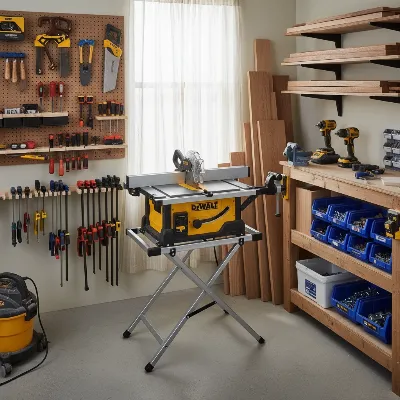 A compact portable table saw set up in a small, organized woodworking shop, surrounded by tools and wood stock.
Detailed Comparison Table of Key Table Saw Features
When selecting a compact portable table saw for a small shop, certain features become paramount. This table outlines the critical specifications and considerations to help you weigh your options effectively.
| Feature | Importance for Small Shops | Typical Specs (Compact/Portable) |
|---|---|---|
| Motor Power | Crucial for cutting various materials without bogging down. | 15 Amps (corded), 18V/FlexVolt (cordless) for hardwoods. |
| Blade Diameter | Determines maximum cutting depth and material capacity. | 8-1/4″ (compact, higher RPM) to 10″ (versatile, deeper cuts). |
| Rip Capacity | Ability to cut wide boards and sheet goods. | 12″ to 32.5″ (often with extendable fences). |
| Fence System | Dictates accuracy and ease of adjustments. | Rack-and-pinion (superior), standard T-square. |
| Portability | Ease of transport, setup, and storage. | 40-60 lbs, integrated handles, rolling/folding stands. |
| Dust Collection | Maintains a cleaner, healthier workspace. | 2.5-inch dust ports, efficient shrouds. |
| Safety Features | Essential for preventing injuries. | Blade guard, riving knife, anti-kickback pawls, emergency stop, flesh-sensing (SawStop). |
| Onboard Storage | Convenience for accessories and tools. | Designated spots for fence, miter gauge, push stick, wrenches. |
Table Saw Buying Guide
Choosing the right compact portable table saw requires careful consideration of your specific woodworking habits, budget, and safety priorities.
Assess Your Needs
|
Our Picks for the Best Table Saw in 2026
As an Amazon Associate I earn from qualifying purchases.
|
||
| Num | Product | Action |
|---|---|---|
| 1 | PROXXON Table Saw FET for Precision Cuts in Wood, Non-Ferrous Metals, Plastics - Adjustable Blade, Extendable Table, Low Noise Motor, 110-120V AC - 37070 |

|
| 2 | SKIL 3601-02 Flooring Saw with 36T Contractor Blade, Red and black |
|
| 3 | VEVOR Band Saw, 9-Inch, Woodworking Benchtop Bandsaw with 1/2 HP Motor, 3.5-Inch Max Cutting Height, 11.8 x 11.8 in Cast Aluminum Table, 0-45° Tilting Range, with Miter Gauge, Fence, for Woodworking |
|
| 4 | 4" 60W MINI ELECTRIC TABLE SAW BENCH TOP GREAT ELECTRIC HOBBY CRAFT TABLE SAW DIY Power Tool Work Bench Stand Circular 2 PIECES Blades |
|
| 5 | POWERTEC Push Block and Push Stick Set Fits Table Saws, Router Tables, Band Saws & Jointers, Dual Ergonomic Handles w/Max Grip, Wood Pusher Reduces Kickback & Increases Safety. 5PK (71009V) |
|
| 6 | SKIL 7-Inch Wet Tile Saw - 3540-02 |
|
| 7 | Woodworking table saw, can be installed in the operating table, 25kg saw blade can be adjusted up and down 55X36X40 cm |
|
| 8 | Lapidary Rock Saw for Cutting Rocks, 750W Mini Lapidary Equipment for Jewelry and Gemstone Polishing, 110V Table Saw Grinder Machine with Polishing Kit for Jade Agate Wood and Beeswax |
|
| 9 | POWERTEC Portable Small Workbench with Vise, Imprinted Ruler and Protractor Scale, Folding Sawhorse/Worktable and 4 Bench Dogs for Woodworking Projects (MT4006V) |
|
| 10 | Skil 3550-02 7-Inch Wet Tile Saw with HydroLock Water Containment System |
|
Before diving into models, honestly evaluate your primary use cases. Will you be ripping long sheets of plywood, making precise crosscuts for small projects, or cutting dados for custom cabinetry? Consider the types of materials you’ll frequently work with—softwoods, hardwoods, or composite materials—and their typical thickness and size. If you’re an occasional hobbyist, a basic benchtop model might suffice. However, if you plan daily projects or work with dense hardwoods, investing in a more powerful contractor-grade saw is advisable.
Budget Considerations
Portable table saws range significantly in price. Benchtop models are typically the most budget-friendly, often falling under $300-$400. Contractor saws with robust stands and features usually range from $400-$800. Premium options, especially those with advanced safety features like SawStop’s flesh-sensing technology, can exceed $800-$1000. Defining your budget upfront will help narrow down the myriad of options.
Key Technical Specifications
Beyond price, delve into the technical details that directly impact performance:
- Power (Amps/Voltage): For corded saws, a 15-amp motor is generally sufficient for cutting through most common hardwoods. Cordless models, typically 18V or higher, offer unmatched mobility but require consideration for battery life and charging.
- Blade Size (Diameter): Most compact portable saws use either an 8-1/4 inch or 10-inch blade. The 10-inch blade offers greater cutting depth and versatility for thicker materials, while 8-1/4 inch blades often achieve higher RPMs for smoother cuts in thinner stock and contribute to a more compact overall design.
- Rip Capacity: This is the maximum width of material you can cut against the fence. For small shops handling occasional sheet goods, a rip capacity of 20-24 inches might be acceptable, but for greater versatility, aim for 24.5 inches or more.
- Adjustability: Look for smooth and precise blade height and bevel adjustments. A bevel range from 0 to 45 degrees is standard, with some offering slight negative bevels (-2 degrees) for undercuts.
Crucial Safety Features
Safety is paramount when operating any table saw. Prioritize models equipped with essential features designed to protect you:
- Blade Guard: A transparent cover that shields the spinning blade.
- Riving Knife: A metal plate positioned behind the blade that moves with it, preventing the cut material from pinching the blade and causing kickback.
- Anti-Kickback Pawls: Toothed devices that grab the workpiece to prevent it from being pushed back towards the operator.
- Emergency Paddle Switch: An oversized, easy-to-hit power-off switch for quick shutdowns.
- Flesh-Sensing Technology: Found primarily in SawStop models, this revolutionary system can detect contact with skin and stop the blade in milliseconds, significantly reducing the risk of severe injury.
Reputable Brands and User Reviews
Leading manufacturers like DeWalt, Skil, Metabo HPT, Milwaukee, Bosch, and SawStop consistently produce high-quality portable table saws. Researching user reviews and professional comparisons can provide valuable insights into a saw’s real-world performance, durability, and any potential quirks. A strong reputation often indicates reliable customer support and readily available parts.
Top Compact Portable Table Saws for Small Shops
The market offers several excellent compact portable table saws that strike a balance between size, power, and precision. Here are some of the standout models often recommended for small shop environments:
Balanced Performance and Value: DeWalt DWE7485 (8-1/4 inch) or Skil TS6307-00 (10 inch)
For many small shop owners, the goal is a capable saw that won’t break the bank.
- DeWalt DWE7485: This 8-1/4 inch model is a perennial favorite for its impressive power, compact size, and high-quality rack-and-pinion fence system, which ensures accurate rip cuts. It’s lighter than many 10-inch models, making it very portable. While its smaller blade limits cutting depth, its high RPM (5,800 RPM) still allows it to slice through hardwoods effectively.
- Skil TS6307-00: Featuring a 10-inch blade and a 15-amp motor, the Skil TS6307-00 offers a solid cutting capacity and comes with an integrated folding stand. Its rack-and-pinion fence system is praised for accuracy, and it often provides excellent value for its feature set, making it a robust choice for a busy small shop.
Premium Power and Features: DeWalt DWE7491RS (10 inch)
If your small shop demands a higher rip capacity and more robust performance, the DeWalt DWE7491RS is often considered a top-tier jobsite saw.
- Pros: Offers a generous 32.5-inch rip capacity, capable of handling full sheets of plywood. It comes with a durable rolling stand for easy transport and a highly accurate rack-and-pinion fence. Its 15-amp motor and 10-inch blade provide ample power for nearly any woodworking task.
- Cons: While portable with its stand, it’s larger and heavier than benchtop models, requiring more storage space when not in use. Its price point is also higher, reflecting its professional-grade features.
Unmatched Safety and Precision: SawStop CTS-120A60 (10 inch)
For those who prioritize safety above all else, especially when working in a home workshop environment, the SawStop Compact Table Saw offers peace of mind.
- Pros: Its patented flesh-sensing technology is revolutionary, stopping the blade within milliseconds of skin contact to prevent serious injury. Beyond safety, it delivers professional-grade cutting performance with a precise rack-and-pinion fence and solid build quality.
- Cons: The significant investment is the primary drawback, making it one of the most expensive compact portable options on the market.
Cordless Mobility: Milwaukee M18 FUEL (8-1/4 inch) / Bosch GTS18V-08N
For ultimate flexibility in a small shop where power outlets might be limited or moving the saw outdoors is common, cordless models provide a compelling solution.
- Milwaukee M18 FUEL: This 8-1/4 inch cordless table saw, powered by Milwaukee’s 18V battery platform, offers impressive cutting power and mobility. It’s lightweight and easy to carry, perfect for quick setup and breakdown.
- Bosch GTS18V-08N: Another strong cordless contender, the Bosch PROFACTOR™ system and BITURBO Brushless™ Technology deliver corded-like performance. Its innovative rack-and-pinion fence and single-handed carry design emphasize convenience and precision.
- Pros (General Cordless): Freedom from cords, ultimate portability, quick setup anywhere.
- Cons (General Cordless): Battery-dependent runtime, often lower rip capacity than corded counterparts, higher initial cost if you don’t already own compatible batteries and chargers.
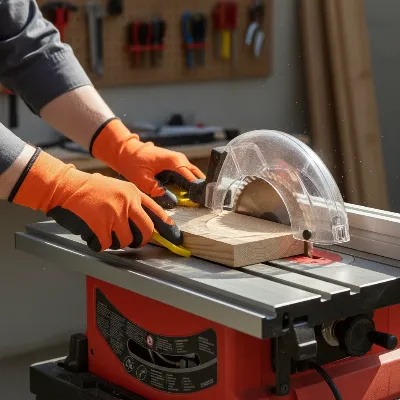 A close-up of a worker safely operating a portable table saw, highlighting safety features like the blade guard and push stick.
Safety When Using a Table Saw
Regardless of your experience level or the saw’s size, safety must always be your top priority. A table saw is a powerful tool, and proper procedures are critical to prevent accidents and ensure a productive woodworking experience.
Personal Protective Equipment (PPE)
Always start by protecting yourself. Don a pair of safety glasses to shield your eyes from flying debris. Hearing protection (earmuffs or earplugs) is essential to prevent long-term hearing damage from the saw’s noise. A dust mask or respirator should be worn to protect your lungs from fine sawdust, especially in enclosed small shops. Avoid loose clothing, jewelry, and ensure long hair is tied back to prevent entanglement with moving parts.
Pre-Operation Checklist
Before powering up your table saw, take a moment for a thorough inspection. Ensure the blade is clean, sharp, and correctly installed for the type of cut you’re making. Verify that the riving knife is properly aligned and operating. Check that the blade guard is in place and functional. Make sure the rip fence is securely locked and parallel to the blade. Finally, clear your workspace of any clutter, off-cuts, or tools that could interfere with the operation or create a tripping hazard. A stable, level machine is non-negotiable for safe operation.
Essential Cutting Techniques
Mastering basic cutting techniques reduces risk significantly. Always maintain a firm grip on your workpiece, keeping your hands away from the blade’s path. Use a push stick or push block for narrower cuts and to keep your hands at a safe distance. For rip cuts, keep the material firmly against the fence. For crosscuts, use a miter gauge or crosscut sled. Always feed the material at a consistent, controlled rate, allowing the blade to do the work without forcing it.
What to Avoid
Never bypass or remove safety features like the blade guard or riving knife unless absolutely necessary for a specific operation (e.g., dado cuts, where specialized guards are required), and always restore them immediately afterward. Avoid distractions, never reach over a spinning blade, and be mindful of potential kickback—where the workpiece is suddenly thrown back at you. Kickback can occur if the material binds between the blade and the fence, or if the riving knife is improperly set. Always use a sharp blade, as dull blades increase the risk of binding and kickback.
“In a small workshop, every inch counts, but so does your safety. Investing in a compact table saw with robust safety features and diligently following operational guidelines can transform your limited space into a productive and secure creative hub.” – Admin of ReviewsArray.com, Table Saw Technician
Conclusion
Choosing the ideal compact portable table saw for your small shop doesn’t have to be a daunting task. By carefully evaluating your woodworking needs, understanding the crucial features like power, rip capacity, and fence system, and prioritizing comprehensive safety mechanisms, you can find a machine that not only fits your physical space but also empowers your creative projects. These agile and powerful tools prove that a small workshop can still be a hub of precision and productivity. Invest wisely in a saw that balances portability with performance, and you’ll unlock a new realm of possibilities in your woodworking journey.
What project are you excited to tackle first with your new compact table saw?
Frequently Asked Questions
Frequently Asked Questions
What is the main difference between a benchtop and a jobsite table saw?
Benchtop table saws are typically smaller, lighter, and designed for placement on an existing workbench, making them highly portable and budget-friendly for hobbyists. Jobsite table saws are generally more robust, often include integrated folding or rolling stands, offer more power and rip capacity, and are built to handle professional demands or more ambitious home projects.
Can a compact table saw effectively cut through hardwoods?
Yes, many compact table saws, especially those with 15-amp motors and sharp 10-inch blades (or high-RPM 8-1/4 inch blades), are perfectly capable of cutting most hardwoods. The key is to use a sharp blade appropriate for the material and to avoid forcing the cut, allowing the saw's power to work efficiently.
What is kickback, and how can I prevent it when using a table saw?
Kickback occurs when a workpiece binds or pinches the saw blade, causing the wood to be violently thrown back towards the operator. To prevent it, always use a riving knife, maintain a sharp blade, keep the fence parallel to the blade, use anti-kickback pawls, and never stand directly in line with the blade. Using a push stick for narrow cuts also helps maintain control and safety.
Is a cordless table saw a worthwhile investment for a small workshop?
A cordless table saw offers unmatched portability and convenience, especially for small shops where power outlets might be scarce or when you need to work in different areas. While they might have slightly less power or shorter rip capacities than their corded counterparts, modern brushless cordless models provide impressive performance for most small to medium-sized projects, making them a valuable investment for ultimate mobility.
What safety features are essential for a portable table saw?
Essential safety features for a portable table saw include a blade guard, a riving knife to prevent kickback, anti-kickback pawls, and an emergency paddle switch for quick shutdowns. Advanced models like SawStop also offer flesh-sensing technology, which can stop the blade in milliseconds upon skin contact.
Choosing a Compact Portable Table Saw for Small Shops
This guide outlines the steps to select the best compact portable table saw for your small woodworking shop, considering needs, budget, and key features.
Evaluate your primary use cases, such as ripping plywood, making crosscuts, or cutting dados. Consider the types of materials (softwoods, hardwoods, composites) and their typical thickness and size you'll work with. This assessment helps determine if a basic benchtop model or a more powerful contractor-grade saw is appropriate.
Portable table saws vary significantly in price. Benchtop models typically cost $300-$400, while contractor saws range from $400-$800. Premium options with advanced safety features can exceed $800-$1000. Establishing your budget upfront will help narrow down suitable options.
Examine power (15-amp motor for corded, 18V+ for cordless), blade size (8-1/4 inch or 10-inch), rip capacity (aim for 24.5 inches or more for versatility), and adjustability (0 to 45-degree bevel range). These specifications directly impact the saw's performance and suitability for your projects.
Look for models equipped with a blade guard, riving knife, anti-kickback pawls, and an emergency paddle switch. Flesh-sensing technology, found in SawStop models, offers superior protection. Prioritizing these features is paramount for preventing accidents.
Consider leading manufacturers like DeWalt, Skil, Metabo HPT, Milwaukee, Bosch, and SawStop. Research user reviews and professional comparisons to gain insights into real-world performance, durability, and customer support. A strong brand reputation often indicates reliable products and readily available parts.

This guide really helped me narrow down my choices. I ended up going with a Bosch benchtop model, and it’s been fantastic for my furniture making projects. It handles crosscutting panels with ease, and the dust collection is better than I expected for a saw in this price range. Definitely a solid investment for anyone with limited space.
I picked up a Ryobi contractor saw based on some recommendations, and while it’s decent for basic DIY tasks, I’ve found the miter gauge to be a bit flimsy. It works for rough cuts, but for precision work like dados, I often have to double-check my measurements. It’s good for the price, but don’t expect perfection.
I’ve been using the DeWalt DWE7485 for a few months now, and it’s exactly what I needed for my tiny garage shop. The compact size means I can tuck it away when not in use, but it still has plenty of power for ripping 2x4s and even some harder woods. The fence system is surprisingly accurate for a portable saw, which was a big concern for me.
As a trim carpenter, I’m constantly moving my tools, and a compact portable table saw is a must-have. The SkilSAW SPT99T-01 has been a game-changer. It’s lightweight enough to carry around, but the worm drive motor gives it serious power for ripping long pieces of trim. It’s made my job so much easier.