For any serious woodworker, a table saw is the undeniable heart of the shop, capable of everything from precise rip cuts to intricate joinery. But to truly unlock its full potential, especially when crafting robust and seamless connections, you need a table saw that can handle a dado blade. Dado blades transform your saw into a specialized groove-cutting machine, essential for shelving, cabinet making, and various forms of intricate joinery. This comprehensive guide will navigate the complexities of table saws with dado blade capacity, helping you identify the perfect machine that aligns with your woodworking aspirations and budget in 2026.
Table Saws: Overview and Essential Applications
A table saw is a cornerstone power tool, featuring a circular blade protruding through the surface of a table. It’s primarily used for making straight, accurate cuts through wood and other materials. Its core functions include ripping (cutting with the grain), crosscutting (cutting across the grain), and making bevel cuts. However, its versatility significantly expands with the addition of a dado blade set.
Dado blades are specialized saw blades designed to cut wide, flat-bottomed grooves in a single pass. These grooves, known as dados or rabbets, are fundamental for creating strong, interlocking joints in woodworking. Whether you’re building sturdy bookshelves with dadoed shelves, crafting cabinet carcasses with robust joinery, or producing detailed box joints, a table saw with dado blade capacity is an indispensable tool, streamlining complex tasks and elevating the quality of your finished projects. For compare top table saws on this site.
Classifying Table Saws and Key Selection Criteria for Dado Use
Not all table saws are created equal when it comes to dado blade compatibility. The type of table saw you own or plan to purchase heavily dictates its ability to handle these specialized blade sets. Understanding the distinctions between common table saw classifications is crucial for making an informed decision.
Benchtop Table Saws
Benchtop table saws are the most compact and portable option, designed for light-duty work and small workshops.
- Pros: Highly portable, space-saving, and generally the most affordable.
- Cons: Often have smaller motors with less power, shorter arbors that may not accommodate a full-width dado stack, and less robust construction leading to reduced precision and stability for dado operations.
- Target Users: Hobbyists, DIY enthusiasts with limited space, or those needing extreme portability for occasional, light dado cuts.
Contractor Table Saws
Contractor table saws offer a step up from benchtop models, providing more power and a larger work surface while still maintaining some portability.
- Pros: Better motor power than benchtop saws, often on a mobile stand, making them suitable for job sites. Many can accept dado blades.
- Cons: While many can accept dado sets, their arbor length can still be a limiting factor for wider stacks, and their open-stand design may not offer the vibration dampening of heavier saws.
- Target Users: Homeowners, enthusiastic DIYers, or contractors who need to move their saw frequently and perform a moderate amount of dado work.
Cabinet Table Saws
|
Our Picks for the Best Table Saw in 2026
As an Amazon Associate I earn from qualifying purchases.
|
||
| Num | Product | Action |
|---|---|---|
| 1 | POWERTEC Push Block and Push Stick Set Fits Table Saws, Router Tables, Band Saws & Jointers, Dual Ergonomic Handles w/Max Grip, Wood Pusher Reduces Kickback & Increases Safety. 5PK (71009V) |

|
| 2 | VEVOR Band Saw, 9-Inch, Woodworking Benchtop Bandsaw with 1/2 HP Motor, 3.5-Inch Max Cutting Height, 11.8 x 11.8 in Cast Aluminum Table, 0-45° Tilting Range, with Miter Gauge, Fence, for Woodworking |
|
| 3 | Woodworking table saw, can be installed in the operating table, 25kg saw blade can be adjusted up and down 55X36X40 cm |
|
| 4 | SKIL 7-Inch Wet Tile Saw - 3540-02 |
|
| 5 | POWERTEC Portable Small Workbench with Vise, Imprinted Ruler and Protractor Scale, Folding Sawhorse/Worktable and 4 Bench Dogs for Woodworking Projects (MT4006V) |
|
| 6 | 4" 60W MINI ELECTRIC TABLE SAW BENCH TOP GREAT ELECTRIC HOBBY CRAFT TABLE SAW DIY Power Tool Work Bench Stand Circular 2 PIECES Blades |
|
| 7 | SKIL 3601-02 Flooring Saw with 36T Contractor Blade, Red and black |
|
| 8 | Skil 3550-02 7-Inch Wet Tile Saw with HydroLock Water Containment System |
|
| 9 | Lapidary Rock Saw for Cutting Rocks, 750W Mini Lapidary Equipment for Jewelry and Gemstone Polishing, 110V Table Saw Grinder Machine with Polishing Kit for Jade Agate Wood and Beeswax |
|
| 10 | PROXXON Table Saw FET for Precision Cuts in Wood, Non-Ferrous Metals, Plastics - Adjustable Blade, Extendable Table, Low Noise Motor, 110-120V AC - 37070 |
|
Cabinet table saws are the pinnacle of table saw design, built for professional shops where power, precision, and durability are paramount.
- Pros: Extremely powerful motors, massive cast-iron tables for stability and vibration reduction, extended rip capacity, and long arbors designed to accommodate the widest dado stacks. They offer superior accuracy and dust collection.
- Cons: Very expensive, heavy, and permanently stationary, requiring a dedicated workshop space.
- Target Users: Professional woodworkers, cabinetmakers, or serious hobbyists who demand the highest precision and frequently perform heavy-duty dado operations.
Hybrid Table Saws
Hybrid table saws bridge the gap between contractor and cabinet saws, aiming to offer the best of both worlds.
- Pros: Enclosed base for improved dust collection and stability, more powerful motors than most contractor saws, and generally good dado compatibility with adequate arbor length. They are typically more affordable and lighter than cabinet saws.
- Cons: Specifications can vary widely between models and brands, so careful review of individual saw specs is essential.
- Target Users: Advanced hobbyists or small shop owners looking for a balance of performance, features, and budget, with consistent dado work needs.
Detailed Comparison of Table Saw Types for Dado Operations
Choosing the right table saw for dado operations involves weighing various factors. The table below provides a comparative overview to help clarify which type best suits different woodworking needs, particularly concerning dado blade capacity.
| Feature | Benchtop Table Saw | Contractor Table Saw | Hybrid Table Saw | Cabinet Table Saw |
|---|---|---|---|---|
| Motor Power | 10-15 Amps | 15 Amps – 1.75 HP | 1.75 HP – 3 HP | 3 HP – 5 HP |
| Arbor Length/Dado | Limited (often < 13/16″) | Often sufficient (5/8″ to 13/16″) | Good (5/8″ to 13/16″) | Excellent (5/8″ to 13/16″+) |
| Precision/Stability | Fair | Good | Very Good | Excellent |
| Portability | High | Moderate | Low | Very Low (Stationary) |
| Price Range | $200 – $500 | $500 – $1,000 | $1,000 – $2,000 | $2,000 – $5,000+ |
| Typical Dado Usage | Light, occasional, narrow | Moderate, standard widths | Frequent, varied widths | Heavy-duty, all applications |
| Dust Collection | Poor to Fair | Fair | Good | Excellent |
Essential Buying Guide: Choosing a Table Saw for Dado Work
Selecting a table saw capable of handling dado blades involves more than just picking a powerful machine. It requires a detailed look at specific features that directly impact performance, safety, and versatility when cutting grooves and joints.
Assess Your Project Needs
Before diving into specifications, consider your primary woodworking goals. How often will you use dado blades? Are you making occasional shallow grooves in plywood for simple shelves, or cutting wide, deep dados in dense hardwoods for elaborate cabinetry? The type and thickness of materials you typically work with, and the precision required for your projects, will guide your choice towards a suitable table saw class and dado blade set.
Budget Considerations
Table saws with robust dado capacity can range significantly in price. Benchtop models might offer basic dado capabilities at a lower cost, while high-end cabinet saws represent a substantial investment. Determine your budget upfront, keeping in mind that a quality dado blade set itself can cost anywhere from $100 to $400. Investing in a saw that provides reliable dado performance will pay dividends in project quality and efficiency.
Critical Specifications
Several technical specifications are paramount when evaluating a table saw for dado blade use:
- Motor Power: Cutting wide dados involves removing a significant amount of material, which demands ample power. Look for saws with at least 1.75 HP (horsepower) or a 15-amp motor for consistent performance, especially when working with hardwoods. Underpowered saws can strain, leading to poor cut quality and increased risk of kickback.
- Arbor Length & Size: This is perhaps the most critical factor. Dado blade sets, particularly stacked ones, are much wider than standard saw blades. Your table saw’s arbor (the shaft the blade mounts on) must be long enough to accommodate the entire dado stack, including shims. Most dado sets require a 5/8-inch arbor, and many are designed to create cuts up to 13/16 inches wide. Always consult your saw’s manual for its maximum dado width and diameter capacity. An 8-inch diameter dado set is common for 10-inch table saws.
- Rip Capacity: While not directly related to dado blades, a generous rip capacity is essential for general woodworking and for maneuvering larger workpieces, which often require dado cuts.
- Fence System: A robust, accurate, and easily adjustable fence is vital for precise dado cuts. Look for fences that lock securely and remain parallel to the blade throughout the cut.
- Table Insert: The standard throat plate on a table saw is designed for a single blade. When using a dado stack, you’ll need a zero-clearance insert specifically cut to the width of your dado blade setup. Ensure your chosen table saw can accommodate aftermarket or custom-made zero-clearance inserts for dado blades, which greatly improve cut quality and safety by reducing tear-out and supporting the workpiece closer to the blade.
 A skilled carpenter precisely cutting a dado groove on a modern table saw with a dado blade installed, sawdust visible, bright workshop setting, realistic photo style.
Indispensable Safety Features
Safety is paramount when operating any power tool, especially a table saw with a dado blade. Look for these critical safety features:
- Blade Guard & Riving Knife: While the main blade guard needs to be removed for dado operations, a removable or retractable riving knife is essential for through cuts. For non-through cuts like dados, the riving knife must be removed, but other safety protocols become even more crucial.
- Emergency Stop: An easily accessible, large paddle-style emergency stop button allows for quick shutdown in case of an incident.
- SawStop Technology: For ultimate safety, SawStop table saws feature flesh-sensing technology that stops the blade almost instantly upon contact with skin. If you choose a SawStop, be aware that you will need a specific dado brake cartridge compatible with their system, and they typically recommend 8-inch stacked dado sets with a maximum thickness of 13/16 inches. Wobble dado sets are not recommended for SawStop saws.
Reputable Brands and User Reviews
Research brands known for quality and reliability in table saws and dado blades. Brands like SawStop, DeWalt, Powermatic, and Grizzly are often highly regarded for their table saws. For dado blade sets, brands such as Freud (Super Dado), Oshlun, CMT, and Diablo are consistently praised for their performance and durability. Always check user reviews for real-world feedback on a saw’s dado performance, ease of setup, and long-term durability.
Top Table Saws with Dado Blade Capacity (by Price Segment)
Identifying the single “best” table saw for dado blade capacity in 2026 is challenging, as the ideal choice depends heavily on individual needs and budget. However, we can highlight consistently recommended models and types known for their excellent dado capabilities across various price segments.
Budget-Friendly Options (Under $700)
In this segment, you’ll typically find jobsite or portable table saws. While they may not offer the brute power or extensive features of larger machines, some models stand out for their ability to accept dado blades and deliver decent performance for hobbyists and light professional use.
- DEWALT DWE7491RS Table Saw: This popular jobsite saw is frequently cited for its robust 15-amp motor and 32-1/2-inch rip capacity, which provides a stable platform for many dado applications. It is known to accommodate an 8-inch dado stack up to 13/16-inch wide, making it a strong contender for its price point. Its rolling stand adds convenient mobility.
- Pros: Good power for a portable saw, excellent fence system, decent dado compatibility, highly portable.
- Cons: Less stable than heavier saws, dust collection can be challenging, may struggle with very wide dados in dense hardwoods over long periods.
Mid-Range Performers ($700-$1,500)
This category often features hybrid table saws, offering a significant upgrade in power, precision, and stability over portable models. They are an excellent choice for serious hobbyists and smaller professional shops seeking a balance of features and cost.
- Grizzly G0771Z Hybrid Table Saw: Grizzly’s hybrid saws are often praised for their solid construction, powerful motors (typically 1.75 HP), and enclosed bases that improve dust collection and stability. They usually feature cast iron tables and sufficient arbor length for full dado stacks, providing a more robust experience for dado operations than jobsite saws.
- Pros: Increased power and stability, better dust collection, cast-iron table, good value for money.
- Cons: Less portable, may not have the absolute precision or durability of premium cabinet saws.
Premium Cabinet Saws (Over $1,500)
For uncompromising power, precision, and safety, premium cabinet saws are the ultimate choice. These machines are built for heavy-duty, continuous use and provide the best environment for all dado cutting needs.
- SawStop Professional Cabinet Saw (PCS) Series: SawStop saws are renowned for their unparalleled safety features, but they also offer exceptional performance. Their Professional Cabinet Saw series, with 3 HP motors and heavy-duty construction, provides superior stability and precision for dado cuts. Remember, a specific dado brake cartridge is required.
- Pros: Unmatched safety, powerful motor, extreme precision and stability, excellent dust collection, robust build quality.
- Cons: High initial cost, requires specific dado brake cartridge, completely stationary.
- Powermatic PM2000B Cabinet Saw: Considered a workhorse in professional shops, the Powermatic PM2000B boasts a powerful motor (often 3-5 HP), massive cast-iron surfaces, and a robust fence system. It’s designed to handle heavy-duty dado operations with superior precision and minimal vibration.
- Pros: Exceptional power and precision, heavy-duty construction, minimal vibration, large work surface, built for continuous use.
- Cons: Very expensive, completely stationary, high power requirements (often 220V).
“The right table saw with dado capacity isn’t just a convenience; it’s a game-changer for joinery. It transforms complex, time-consuming tasks into precise, repeatable operations, fundamentally elevating the craftsmanship of any project.”
Ensuring Safety When Operating a Table Saw with Dado Blades
Operating a table saw, especially with a dado blade, demands unwavering attention to safety. Dado blades remove more material and create different stresses on the saw and workpiece, necessitating specific precautions.
Personal Protective Equipment (PPE)
Always start with the right protective gear:
- Safety Glasses: Essential to protect your eyes from flying debris.
- Hearing Protection: Dado blades can be very loud, so earmuffs or earplugs are crucial.
- Dust Mask/Respirator: To prevent inhaling fine wood dust, especially when dust collection may be less efficient with a dado stack.
- Gloves: Generally, gloves are not recommended when operating a table saw as they can snag on the blade or workpiece, but a good technician should have them on hand for setup and cleanup. Keep clothing tight and avoid loose sleeves.
Pre-Operation Checks
Before powering on your saw with a dado stack:
- Blade Condition: Inspect the dado blades and chippers for any damage or dullness.
- Arbor Nut Tightness: Ensure the arbor nut is securely tightened to prevent the dado stack from loosening during operation. However, avoid over-tightening, which can damage the arbor.
- Fence Alignment: For rip-style dado cuts, ensure the rip fence is perfectly parallel to the blade. Any misalignment can cause binding and kickback.
- Clear Workspace: Remove all scraps, tools, and clutter from the table saw surface and surrounding area.
- Zero-Clearance Insert: Confirm the correct zero-clearance insert for your dado width is in place and secured.
Fundamental Dado Cutting Techniques
- Use a Crosscut Sled or Miter Gauge: For cross-grain dado cuts, always use a crosscut sled or your miter gauge. Never use the rip fence and the miter gauge simultaneously, as this creates a pinch point and can cause severe kickback.
- Multiple Shallow Passes: If cutting a wide or deep dado, especially in dense material or with an underpowered saw, consider making multiple shallow passes instead of one deep pass. This reduces strain on the motor and lessens the risk of kickback.
- Proper Workpiece Support: Ensure the workpiece is fully supported throughout the cut. Use an outfeed table for longer pieces to prevent tipping after the cut.
- Riving Knife Removal: Remember that for non-through cuts like dados, the riving knife must be removed. This means you must be extra vigilant about kickback prevention.
Avoiding Common Hazards
- Kickback Prevention: Always maintain firm control of the workpiece. Use push sticks and push blocks to keep your hands away from the blade. Never stand directly in line with the blade; stand to the side.
- Hand Placement: Keep hands a safe distance from the spinning dado blade. A good rule of thumb is at least 6 inches away.
- Power-Off Adjustments: Always turn off and unplug the saw before making any adjustments to the dado stack, fence, or other components. Wait for the blade to come to a complete stop.
- No Freehand Cutting: Never attempt to cut dados freehand. Always use a fence, miter gauge, or sled.
- SawStop Specifics: If using a SawStop table saw, always install the correct dado brake cartridge and corresponding throat plate. Ensure the carbide teeth of the dado stack are not pressing against each other when assembled, as this can cause damage.
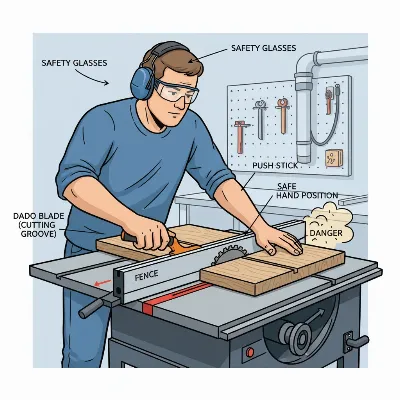 Woodworker wearing safety gear using a push stick on a table saw with a dado blade for a safe cut, with focus on safety protocols, instructional style illustration.
Conclusion
Equipping your workshop with a table saw that possesses robust dado blade capacity is a transformative step for any woodworker. It’s the key to crafting strong, aesthetically pleasing joinery for everything from custom cabinetry to bespoke furniture. In 2026, the market continues to offer a diverse range of options, from powerful portable saws to precision-engineered cabinet models, all capable of enhancing your project versatility and quality when paired with the right dado blade set.
When making your selection, prioritize sufficient motor power, adequate arbor length for your desired dado stack, and robust safety features. Whether you’re a seasoned professional or a dedicated hobbyist, investing in a table saw with reliable dado capacity will undoubtedly expand your woodworking horizons and help you achieve exceptional results. What intricate joinery project will you tackle first with your new dado-capable table saw?
Frequently Asked Questions
What is a dado blade used for?
A dado blade is a specialized set of saw blades used on a table saw or radial arm saw to cut wide, flat-bottomed grooves (dados) or rabbets into wood. These grooves are essential for creating strong, interlocking joints in cabinetry, shelving, and various woodworking projects.
Can all table saws use dado blades?
No, not all table saws can use dado blades. Compatibility depends primarily on the saw’s arbor length, which must be long enough to accommodate the wider dado stack. Additionally, adequate motor power and the ability to use a specialized throat plate are necessary. Always check your table saw’s manual for dado compatibility.
What’s the difference between a stacked dado set and a wobble blade?
A stacked dado set consists of two outer blades and multiple inner chipper blades and shims. This configuration creates clean, flat-bottomed dados with precise width adjustment. A wobble blade, on the other hand, uses a single blade that tilts to vary the cut width, often resulting in curved dado bottoms and increased vibration. Stacked sets are generally preferred for superior cut quality and precision.
What safety precautions are essential when using a dado blade?
When using a dado blade, it’s crucial to wear personal protective equipment (safety glasses, hearing protection, dust mask), ensure the saw’s arbor nut is tight, and use a zero-clearance insert. Always use a crosscut sled or miter gauge (never the rip fence simultaneously) and use push sticks to keep hands clear. For non-through cuts, the riving knife must be removed, requiring heightened vigilance against kickback.
How do you adjust the width of a dado cut?
With a stacked dado set, you adjust the width of the cut by adding or removing chipper blades and thin shims between the two outer blades. This modular system allows for precise, incremental adjustments to achieve the exact desired dado width. Trial and error with scrap wood is often used to fine-tune the setting.
