The table saw is a cornerstone of many workshops, a powerful tool that transforms raw lumber into precision-cut pieces. Yet, with great power comes significant responsibility, and few dangers loom larger in the woodworking world than kickback. This sudden, violent ejection of wood can turn a productive moment into a harrowing accident, leading to severe injuries or damaged materials. Understanding the mechanics of kickback and implementing robust safety protocols isn’t just a recommendation; it’s essential for anyone who values their well-being and their craft. This guide will walk you through the primary causes of kickback, the critical safety devices designed to prevent it, and the best practices you can adopt to keep your shop safe and your cuts smooth.
Table Saw Kickback: Understanding the Dangers and Causes
Kickback occurs when a workpiece, or a portion of it, is unexpectedly and violently propelled back towards the operator by the spinning table saw blade. This phenomenon can happen at astonishing speeds, sometimes exceeding 100 miles per hour, making it nearly impossible to react once it begins. The consequences can be devastating, ranging from deep lacerations and broken bones to finger amputations and serious internal injuries, not to mention costly damage to your workshop and materials.
Several factors contribute to table saw kickback, often in combination:
Pinching and Binding: This is perhaps the most common cause. When the wood being cut becomes trapped between the blade and another stationary object, such as the rip fence, or when the kerf (the slot made by the blade) closes around the blade, kickback is imminent.
- Misaligned Fence: If your rip fence is not perfectly parallel to the blade, or is “toed-in” (closer to the blade at the back than at the front), the wood can bind and pinch the blade, forcing it backward.
- Internal Wood Stresses: Wood, especially kiln-dried lumber, can have internal stresses. As you cut, these stresses are released, causing the kerf to close around the blade. This is particularly common with warped, knotty, or “springy” wood.
- Dull or Dirty Blade: A dull blade requires more force to push the wood through, increasing friction and heat, which can cause the blade to warp or the wood to burn and bind. Pitch or sap buildup on the blade also increases its effective thickness, leading to more friction and binding.
- Improper Featherboard Placement: While featherboards are excellent for holding stock against the fence, if placed beyond the blade on the outfeed side, they can inadvertently pinch the wood against the blade, causing kickback.
Riding Over the Blade: This happens when the workpiece lifts off the table and its back edge catches the upward-rotating teeth at the rear of the blade. The blade then slingshots the wood back at you.
- Lack of Downward Pressure: Failing to maintain firm, consistent downward pressure on the workpiece can allow it to lift and ride up on the blade.
- Uneven Stock: Wood with unjointed edges or warped faces will not sit flat or slide smoothly against the fence, making it prone to lifting or twisting.
Improper Cutting Techniques: Certain techniques drastically increase the risk of kickback.
- Freehand Cutting: Attempting to cut wood without using a fence, miter gauge, or sled provides no stability, allowing the wood to wander and easily bind.
- Backing Out of a Cut: Pulling the workpiece back out of a partially completed cut allows the blade’s teeth to grab the wood in the wrong direction.
- Not Following Through: Stopping a cut before the entire workpiece has cleared the blade’s rear means the offcut or main piece can become unstable and kick back.
- Using Miter Gauge and Rip Fence Simultaneously for Crosscuts: This creates a dangerous pinch point where the wood is constrained on two sides, virtually guaranteeing kickback as the cut progresses.
- Drop Cutting: Starting a cut in the middle of a board by lowering it onto a spinning blade is extremely risky and can eject the board violently.
Essential Safety Devices and Their Role in Preventing Kickback
While technique is paramount, several safety devices are specifically engineered to provide an extra layer of protection against the unpredictable forces of kickback. Integrating these tools into your workflow can significantly enhance your safety.
Riving Knives
|
Our Picks for the Best Table Saw in 2026
As an Amazon Associate I earn from qualifying purchases.
|
||
| Num | Product | Action |
|---|---|---|
| 1 | POWERTEC Push Block and Push Stick Set Fits Table Saws, Router Tables, Band Saws & Jointers, Dual Ergonomic Handles w/Max Grip, Wood Pusher Reduces Kickback & Increases Safety. 5PK (71009V) |

|
| 2 | SKIL 7-Inch Wet Tile Saw - 3540-02 |
|
| 3 | POWERTEC Portable Small Workbench with Vise, Imprinted Ruler and Protractor Scale, Folding Sawhorse/Worktable and 4 Bench Dogs for Woodworking Projects (MT4006V) |
|
| 4 | Woodworking table saw, can be installed in the operating table, 25kg saw blade can be adjusted up and down 55X36X40 cm |
|
| 5 | Skil 3550-02 7-Inch Wet Tile Saw with HydroLock Water Containment System |
|
| 6 | PROXXON Table Saw FET for Precision Cuts in Wood, Non-Ferrous Metals, Plastics - Adjustable Blade, Extendable Table, Low Noise Motor, 110-120V AC - 37070 |
|
| 7 | VEVOR Band Saw, 9-Inch, Woodworking Benchtop Bandsaw with 1/2 HP Motor, 3.5-Inch Max Cutting Height, 11.8 x 11.8 in Cast Aluminum Table, 0-45° Tilting Range, with Miter Gauge, Fence, for Woodworking |
|
| 8 | 4" 60W MINI ELECTRIC TABLE SAW BENCH TOP GREAT ELECTRIC HOBBY CRAFT TABLE SAW DIY Power Tool Work Bench Stand Circular 2 PIECES Blades |
|
| 9 | SKIL 3601-02 Flooring Saw with 36T Contractor Blade, Red and black |
|
| 10 | Lapidary Rock Saw for Cutting Rocks, 750W Mini Lapidary Equipment for Jewelry and Gemstone Polishing, 110V Table Saw Grinder Machine with Polishing Kit for Jade Agate Wood and Beeswax |
|
A riving knife is a crucial safety component that sits directly behind and in line with the saw blade. Unlike older splitters, a true riving knife moves up and down and tilts with the blade, maintaining a consistent, very close distance to the blade’s teeth.
> “A properly aligned riving knife is your best friend at the table saw; it’s consistently working to keep that kerf open and prevent the most common causes of kickback.” – John Smith, Master Woodworker, ReviewsArray.com
Its primary function is to prevent the kerf from closing in on the back of the blade, thereby eliminating pinching and binding. It also helps prevent small offcuts from rising and contacting the back of the blade. Because it moves with the blade, a riving knife typically does not need to be removed for non-through cuts like dados or grooves, making it a more convenient and consistently used safety feature compared to traditional splitters. Many modern table saws manufactured since 2007 include riving knives as standard equipment due to their superior safety performance.
Splitters
A splitter serves a similar purpose to a riving knife but has a fixed position relative to the saw table. It’s a thin piece of metal mounted behind the blade, designed to keep the kerf open.
The main disadvantage of a splitter is that it does not move with the blade’s height or angle adjustments. This means that if you lower the blade for a shallow cut, the gap between the blade and the splitter widens, reducing its effectiveness. For non-through cuts, a splitter often needs to be removed entirely, which increases the likelihood of an operator forgetting to reinstall it for through cuts. While less effective than a riving knife, a well-aligned splitter is still far better than no protection at all, especially on older saws that cannot accommodate a riving knife.
Anti-Kickback Pawls
Anti-kickback pawls are typically jagged, spring-loaded teeth that are mounted to the blade guard or a riving knife assembly. Their design allows wood to pass underneath them in the forward direction but bites into the wood if it attempts to kick back.
These pawls act as a one-way clutch, digging into the workpiece and preventing its backward motion in the event of kickback. They add another layer of security, especially when combined with a riving knife, by physically impeding the wood’s dangerous return path.
Blade Guards
A blade guard is a transparent cover that sits over the top of the saw blade, usually incorporating dust collection. Its primary role is to shield the operator from direct contact with the spinning blade and to contain sawdust.
Beyond protecting your hands and fingers, a blade guard also serves to prevent wood from flying up or contacting the top of the blade prematurely. Many modern guards are designed to be minimally intrusive while offering maximum protection, often integrating anti-kickback pawls and excellent dust collection capabilities.
Featherboards
Featherboards are essential accessories that apply consistent pressure to the workpiece, holding it firmly against the table or the rip fence. They consist of a series of flexible “fingers” that bend as the wood passes but resist backward motion.
The correct placement of a featherboard is critical: it must always be mounted on the infeed side of the blade, pressing the material towards the fence or down onto the table before it reaches the blade. If a featherboard is placed on the outfeed side, past the blade, it can create a pinch point, leading to kickback. When used correctly, featherboards ensure stable, controlled feeding, reducing the chance of the workpiece wandering or vibrating.
Push Sticks and Push Blocks
Push sticks and push blocks are indispensable tools for keeping your hands a safe distance from the spinning blade, especially when cutting narrow or small pieces of wood. These simple devices allow you to maintain full control over the workpiece throughout the entire cut.
A good push stick will not only push the stock forward but also apply downward pressure to keep it flat on the table and inward pressure to keep it against the fence. It’s advisable to have a variety of push sticks and blocks to suit different cuts and workpiece sizes. Always use a push stick to complete any cut where your hands would otherwise come close to the blade, particularly when finishing a cut and the trailing edge of the material approaches the blade. Never rely on your bare hands for close-range pushes.
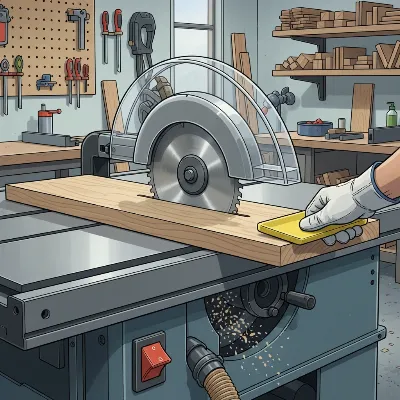 Essential table saw safety devices like a riving knife, push stick, and blade guard in use
Best Practices and Techniques for Safe Table Saw Operation
Beyond specialized equipment, adopting a disciplined approach to your table saw work is the most powerful defense against kickback. Safe operation begins before the cut and continues until the saw blade comes to a complete stop.
Pre-Cut Checks
Before you even power on your table saw, a thorough inspection and preparation routine can prevent most kickback scenarios.
- Sharp and Clean Blade: Ensure your blade is sharp, clean, and free of pitch buildup. A dull or dirty blade increases friction and the likelihood of binding. Use the correct blade type for the material and cut.
- Fence Alignment: Crucially, verify that your rip fence is perfectly parallel to the saw blade. Even a slight misalignment can cause the wood to pinch. Use a dial indicator or a reliable measurement method to check parallelism regularly.
- Wood Inspection: Always inspect your lumber for knots, warps, twists, or foreign objects like nails or screws. These irregularities can cause the blade to bind or catch unexpectedly. Avoid cutting severely warped or twisted wood on a table saw.
- Blade Height Setting: Set the blade height so that it extends approximately one tooth above the workpiece. This allows the blade to cut more efficiently and reduces the exposed blade area, minimizing the chance of the wood riding over it.
- Safety Devices Check: Confirm that your riving knife (or splitter) and blade guard are correctly installed and aligned. Never bypass these critical safety features.
Proper Cutting Techniques
Your body mechanics and how you interact with the saw during the cut play a massive role in kickback prevention.
- Consistent Feed Rate: Feed the material at a steady, consistent pace. Forcing the wood too quickly can overwhelm the blade, while feeding too slowly can lead to burning and increased friction.
- Three-Directional Pressure: When ripping, apply firm pressure in three directions: forward (to feed the wood), downward (to keep it flat on the table), and inward (to keep it tight against the fence). This consistent control prevents the wood from wandering, lifting, or twisting.
- Push Through Completely: Always push the workpiece completely past the back of the blade. The cut isn’t truly finished until the material clears the rear teeth, preventing the offcut or main piece from being caught and thrown.
- Avoid Twisting: Never twist the board as it passes through the blade. Any lateral movement can cause the wood to bind between the blade and the fence, leading to violent kickback.
- Stand to the Side: Position yourself slightly to the side of the blade’s path, rather than directly behind it. If kickback occurs, the workpiece will be ejected along this path, and standing clear minimizes your risk of being struck.
- Use Crosscut Sleds Safely: For crosscutting, always use a miter gauge or, preferably, a crosscut sled. Never use the rip fence as a stop block in conjunction with a miter gauge or sled, as this creates a dangerous pinch point. Instead, if using the fence as a length stop, clamp a sacrificial block to the fence in front of the blade so the cut-off piece can clear the fence after the cut.
- No Freehand Cuts: Absolutely never attempt to cut wood freehand on a table saw. Always use a fence, miter gauge, or sled to guide the material.
Workshop Environment
A safe table saw operation extends to the surrounding workspace.
- Clear Workspace: Maintain a clear, uncluttered work area around your table saw. Remove any debris or tools that could interfere with your movement or the path of ejected material.
- Adequate Lighting: Ensure your workshop has bright, even lighting to clearly see your workpiece, blade, and safety devices.
- Outfeed Support: Always use outfeed support for long pieces of wood. This could be a dedicated outfeed table, roller stands, or even a sturdy temporary setup. Outfeed support prevents the workpiece from tipping, binding, or losing control as it exits the blade.
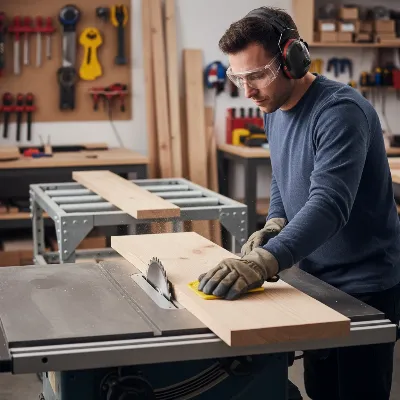 Woodworker demonstrating safe table saw cutting technique with push stick and proper stance
Preventing Kickback: A Detailed Comparison of Riving Knives vs. Splitters
When it comes to preventing kickback by keeping the kerf open, both riving knives and splitters serve a similar purpose. However, their design and functionality lead to significant differences in effectiveness and user convenience. Here’s a detailed comparison:
| Feature | Riving Knife | Splitter |
|---|---|---|
| Movement | Moves synchronously with the blade (height & tilt). | Fixed to the throat plate; does not move with the blade. |
| Proximity | Stays consistently close to the blade’s rear teeth. | Gap between blade and splitter increases as blade is lowered. |
| Non-Through Cuts | Can remain installed for most non-through cuts (e.g., dadoes, grooves). | Often must be removed for non-through cuts. |
| Effectiveness | Superior; offers consistent protection throughout the entire range of blade heights and angles. Minimizes potential pinch points. | Good, but less consistent. Its effectiveness diminishes with lower blade heights, creating a larger gap where small pieces can bind. |
| Installation | Standard on most modern table saws (post-2007 in many regions). Integrated into the saw’s arbor. | Common on older table saws. Aftermarket splitters are available for some models. |
| Convenience | High; rarely needs removal, promoting consistent use. | Lower; frequent removal for specific cuts can lead to it being left off. |
While a splitter is certainly better than no anti-kickback device at all, the integrated design and dynamic movement of a riving knife provide a significantly safer and more user-friendly experience, making it the preferred choice for kickback prevention.
Understanding Table Saw Kickback: Causes, Prevention, and Best Practices
To truly master table saw safety and prevent kickback, it’s not enough to just know the dangers; you need a comprehensive strategy that influences your tool selection, maintenance, and daily habits.
Prioritizing Safety Features When Choosing a Table Saw
If you’re in the market for a new table saw, make safety features a top priority.
- Integrated Riving Knife: Look for saws that come equipped with a true riving knife. This is arguably the single most important kickback prevention feature.
- Robust Blade Guard and Anti-Kickback Pawls: Opt for saws with a well-designed blade guard that offers good visibility and integrates effective anti-kickback pawls.
- Precision Fence System: A high-quality fence that is easy to align and stays parallel to the blade is critical for preventing binding. Slop or inaccuracy in the fence system is a recipe for kickback.
- Quick-Stop Blade Technology: While not directly preventing kickback, features like SawStop’s blade braking technology can dramatically reduce injury severity if kickback (or any blade contact) occurs, bringing the blade to a stop in milliseconds.
Developing a Safety Mindset
Safety on a table saw is as much about your mental approach as it is about equipment.
- Personal Protective Equipment (PPE): Always wear safety glasses or a face shield, hearing protection, and appropriate clothing (no loose sleeves or jewelry).
- Never Rush: Rushing leads to mistakes. Take your time, set up your cuts carefully, and don’t work when you’re tired or distracted.
- Stay Focused: The table saw demands your full, undivided attention. Avoid distractions in the workshop.
- Know Your Limits: Understand your saw’s capabilities and, more importantly, your own. Don’t attempt cuts that feel unsafe or beyond your skill level. Acknowledge when you need more experience, a different tool, or a different approach.
Top Tips for Minimizing Risk of Kickback
Even with the best equipment and techniques, vigilance and ongoing attention to detail are key to consistently minimizing kickback risk.
Maintaining Your Saw and Blades
Regular maintenance is a non-negotiable aspect of table saw safety.
- Regular Blade Cleaning: Pitch and sap buildup on saw blades significantly increases friction. Use a blade cleaner regularly to keep your blades free of residue.
- Prompt Blade Replacement: A dull blade forces you to push harder, increasing friction and the risk of kickback. Replace or sharpen dull blades promptly.
- Fence Alignment Checks: Make it a habit to check your fence’s parallelism to the blade, especially after moving the saw or if you notice any unusual cutting behavior.
Wood Preparation
The condition of your material directly impacts the safety of your cut.
- Only Cut Flat, Straight, Dry Wood: Avoid attempting to cut severely warped, twisted, or bowed lumber on a table saw. These pieces are inherently unstable and prone to binding. If you must process such wood, consider using a jointer, planer, or even a bandsaw first to create a flat reference face and edge.
- Account for Internal Stresses: Be particularly cautious with long rip cuts on hardwoods or certain types of softwood where internal stresses might be high. The kerf can close unexpectedly. Ensure your riving knife is in place.
Strategic Workpiece Handling
How you handle the wood through the cut can make all the difference.
- Utilize Outfeed Support: For any piece of wood that extends beyond the rear of the table saw, outfeed support is crucial. This maintains control over the workpiece, preventing it from tipping or twisting as it leaves the blade, which can induce kickback.
- Employ Zero-Clearance Inserts: A zero-clearance insert replaces your saw’s standard throat plate, providing a tight opening around the blade. This minimizes tear-out and, more importantly, provides full support to the workpiece right up to the blade, preventing small offcuts from falling into the blade cavity and becoming dangerous projectiles or binding agents.
Conclusion
Table saw kickback is a formidable hazard, but it is not an unavoidable one. By understanding its underlying causes, diligently using essential safety devices like riving knives and anti-kickback pawls, and consistently practicing safe cutting techniques, you can drastically reduce its occurrence. From thorough pre-cut checks to maintaining your equipment and always focusing on the task at hand, every step contributes to a safer workshop. Ultimately, the best defense against kickback is a combination of proper tools, smart habits, and an unwavering commitment to safety.
What single safety practice has made the biggest difference in your woodworking journey?
Câu Hỏi Thường Gặp
What exactly is table saw kickback?
Table saw kickback is when the spinning saw blade forcefully throws the piece of wood being cut back toward the operator, often at very high speeds. It’s a dangerous event caused by the wood binding or catching on the blade.
How does a riving knife prevent kickback?
A riving knife is a safety device positioned directly behind and in line with the saw blade. It moves with the blade’s height and tilt, keeping the cut kerf open and preventing the wood from pinching the blade, which is a primary cause of kickback.
Can a dull blade cause kickback?
Yes, a dull blade can definitely cause kickback. It requires more force to push the wood through, leading to increased friction, heat buildup, potential blade warping, and binding of the wood around the blade, all of which contribute to kickback.
Is kickback common even for experienced woodworkers?
Unfortunately, kickback can happen to anyone, regardless of experience. Even seasoned woodworkers can encounter kickback if they become complacent, use improper techniques, or don’t maintain their equipment and workpiece correctly.
Why shouldn’t I stand directly behind the blade?
Standing directly behind the blade puts you squarely in the path of a potential kickback. If the wood is ejected, it will likely travel directly towards you, increasing your risk of serious injury. Standing slightly to the side keeps you out of the direct line of fire.
What’s the most important safety device to prevent kickback?
While several devices are important, a true riving knife is widely considered the most crucial safety device for preventing kickback on a table saw. Its ability to continuously keep the kerf open directly addresses the leading cause of kickback.