For many DIY enthusiasts, the table saw is the undisputed centerpiece of the workshop, a powerhouse of precision and versatility when it comes to woodworking. Its ability to make straight, accurate cuts in various wood types makes it indispensable. However, as projects often extend beyond timber to include metals like aluminum, a common question arises: can this woodworking staple be safely adapted for aluminum cutting? While the short answer is “yes, under very specific and strict conditions,” this seemingly simple affirmative carries significant caveats and inherent risks that any conscientious DIYer must thoroughly understand. Attempting to cut aluminum with a standard wood table saw without proper modifications and stringent safety protocols can lead to serious injury, damage to your machine, and unsatisfactory results. This guide will meticulously break down the considerations, essential adjustments, and critical safety measures required to approach this task with the utmost care, ensuring you can make informed decisions for your next project.
Table Saw: An Overview and Its Primary Applications
A table saw is a powerful workshop tool consisting of a circular saw blade, mounted on an arbor, that protrudes through the surface of a table. The blade height and angle can be adjusted, allowing for precise cuts through various materials. Its design prioritizes accuracy and efficiency for ripping, cross-cutting, mitering, and dadoing wood. The fixed nature of the blade and the large, stable table surface make it ideal for handling larger workpieces and achieving repeatable cuts, distinguishing it from portable saws like circular saws or miter saws.
On the market, table saws are broadly categorized by their size, power, and portability:
- Benchtop Table Saws: Compact and portable, often used by hobbyists or for job site work where space is limited. They are typically less powerful.
- Contractor Table Saws: Heavier than benchtop models, offering more power and stability, but still relatively portable for transport to different job sites.
- Hybrid Table Saws: Bridging the gap between contractor and cabinet saws, these offer improved dust collection, heavier construction, and often more powerful motors, appealing to serious hobbyists and small shop owners.
- Cabinet Table Saws: The heaviest and most powerful, designed for permanent placement in professional workshops. They offer superior precision, power, and vibration dampening.
These machines are the backbone of woodworking, crucial for tasks ranging from framing houses and building furniture to crafting intricate joinery. Their robust construction and powerful motors are engineered to handle the specific physical properties of wood—a relatively soft, fibrous material. However, when considering aluminum, a non-ferrous metal with distinct characteristics, the standard table saw’s design parameters are pushed beyond their intended limits, necessitating a deep understanding of its conditional suitability for such tasks.
Cutting Aluminum with a Table Saw: Is It Possible?
The prospect of using a familiar and versatile table saw for aluminum is tempting for many DIYers. The direct answer is that, yes, it is technically possible to cut aluminum with a table saw, but this comes with significant risks and demands a highly controlled environment and specialized setup. It’s crucial to understand that a table saw is fundamentally engineered for wood, an organic material with vastly different properties than aluminum.
Aluminum is a softer, non-ferrous metal, but it is also much more prone to sticking and binding to a blade than wood. This characteristic, often referred to as “chip welding” or “gumming up,” can lead to extremely dangerous situations. When a standard wood blade, with its aggressive tooth geometry, attempts to cut aluminum, the material can grab, bind, and be violently ejected from the saw. This phenomenon, known as kickback, is a leading cause of serious injuries in woodworking, and its danger is amplified when working with metal. The motor and bearings of a table saw are designed for the lower cutting forces associated with wood; cutting metal, especially thicker stock, imposes considerable stress, potentially leading to premature machine wear or damage. Furthermore, the chips produced from cutting aluminum are small, sharp, and hot, posing a direct injury risk and a significant fire hazard if they mix with accumulated wood dust inside the saw or in a dust collection system.
Essential Blade Selection for Aluminum
The single most critical modification when preparing to cut aluminum on a wood table saw is the blade. Using a standard wood saw blade for aluminum is unequivocally negligent and extremely dangerous, as it dramatically increases the risk of kickback, binding, and blade damage.
Why Your Wood Blade Won’t Work
|
Our Picks for the Best Table Saw in 2026
As an Amazon Associate I earn from qualifying purchases.
|
||
| Num | Product | Action |
|---|---|---|
| 1 | 4" 60W MINI ELECTRIC TABLE SAW BENCH TOP GREAT ELECTRIC HOBBY CRAFT TABLE SAW DIY Power Tool Work Bench Stand Circular 2 PIECES Blades |

|
| 2 | SKIL 3601-02 Flooring Saw with 36T Contractor Blade, Red and black |
|
| 3 | POWERTEC Push Block and Push Stick Set Fits Table Saws, Router Tables, Band Saws & Jointers, Dual Ergonomic Handles w/Max Grip, Wood Pusher Reduces Kickback & Increases Safety. 5PK (71009V) |
|
| 4 | POWERTEC Portable Small Workbench with Vise, Imprinted Ruler and Protractor Scale, Folding Sawhorse/Worktable and 4 Bench Dogs for Woodworking Projects (MT4006V) |
|
| 5 | Woodworking table saw, can be installed in the operating table, 25kg saw blade can be adjusted up and down 55X36X40 cm |
|
| 6 | Skil 3550-02 7-Inch Wet Tile Saw with HydroLock Water Containment System |
|
| 7 | VEVOR Band Saw, 9-Inch, Woodworking Benchtop Bandsaw with 1/2 HP Motor, 3.5-Inch Max Cutting Height, 11.8 x 11.8 in Cast Aluminum Table, 0-45° Tilting Range, with Miter Gauge, Fence, for Woodworking |
|
| 8 | PROXXON Table Saw FET for Precision Cuts in Wood, Non-Ferrous Metals, Plastics - Adjustable Blade, Extendable Table, Low Noise Motor, 110-120V AC - 37070 |
|
| 9 | Lapidary Rock Saw for Cutting Rocks, 750W Mini Lapidary Equipment for Jewelry and Gemstone Polishing, 110V Table Saw Grinder Machine with Polishing Kit for Jade Agate Wood and Beeswax |
|
| 10 | SKIL 7-Inch Wet Tile Saw - 3540-02 |
|
Wood blades are designed with a positive hook or rake angle, meaning the teeth lean forward, aggressively “biting” into the wood. This geometry is perfect for quickly tearing through wood fibers but is disastrous for aluminum. Aluminum, being a softer metal, will catch and grab these aggressive teeth, leading to violent kickback. Additionally, wood blades typically have fewer teeth (e.g., 24-50 TPI for ripping wood), which results in larger gullets designed for efficient wood chip evacuation. When cutting aluminum, these large gullets can quickly become clogged with sticky aluminum chips, causing excessive heat buildup, gumming, and binding.
The Right Blade: Non-Ferrous Metal Blades
To safely and effectively cut aluminum, you must replace your wood blade with one specifically designed for non-ferrous metals. These specialized blades have features that counteract the unique challenges of cutting aluminum:
- Carbide-Tipped: Blades with carbide tips are much harder and more durable than regular steel, allowing them to retain their edge longer when cutting a softer, gummy metal like aluminum. These tips are crucial for a clean, efficient cut and extended blade life.
- Negative Rake Angle: This is arguably the most important characteristic. Unlike the positive angle of wood blades, non-ferrous metal blades feature a negative rake angle (typically -5° to -10°). The teeth are angled slightly backward, causing them to scrape or shear the material rather than aggressively biting into it. This significantly reduces the risk of snagging, binding, and dangerous kickback, leading to a much smoother and more controlled cut.
- High Tooth Count (60-100 TPI): A higher tooth count results in smaller chips and a smoother cut. Blades with 60 to 100 teeth minimize the impact of each tooth on the material, reducing the chance of chipping and tearing, which is common with aluminum.
- Triple Chip Grind (TCG): TCG teeth are specifically designed for cutting non-ferrous metals and plastics. This grind pattern features alternating teeth: one flat-top tooth cuts the center of the kerf, followed by a chamfered tooth that cuts the corners. This design distributes the cutting load, reduces heat buildup, and ensures clean, burr-free cuts, preventing the aluminum from sticking and improving chip evacuation.
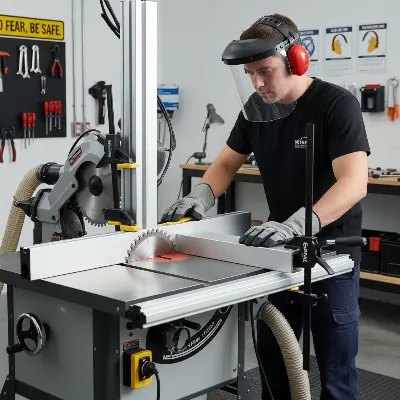 Table saw with non-ferrous blade, clamped aluminum, and PPE for safe cutting
Crucial Safety Measures for Cutting Aluminum
Given the inherent risks, safety is paramount when cutting aluminum on a table saw. Ignoring any of these measures can lead to severe injury.
Personal Protective Equipment (PPE) is Non-Negotiable
When cutting aluminum, the hazards extend beyond just the spinning blade. Hot, sharp metal chips, loud noise, and fine dust are significant concerns. Therefore, standard safety glasses are insufficient.
- Full Face Shield: This is mandatory. Hot, sharp-edged aluminum chips are ejected at high speeds and can cause serious facial and eye injuries. A full polycarbonate face shield provides comprehensive protection.
- Hearing Protection: Cutting metal on a table saw produces a deafening noise that can cause permanent hearing damage over time. Earplugs or earmuffs are essential.
- Respiratory Protection: Fine aluminum dust is generated during cutting. This dust is easily inhaled and can accumulate in the lungs, leading to serious respiratory conditions like pneumoconiosis (“metal lung disease”). Furthermore, aluminum dust is highly flammable and explosive when airborne. A properly fitted dust mask or respirator is critical.
- Sturdy, Fitted Clothing: Avoid loose sleeves, dangling drawstrings, or any clothing that could get caught by the spinning blade. Sturdy, long-sleeved shirts and pants, or even a leather apron, can offer additional protection from flying chips. Do not wear gloves that could get caught in the blade; if gloves are worn, ensure they are snug-fitting and cut-resistant, and only used if they do not increase the risk of entanglement.
Securing Your Workpiece
Kickback is the most dangerous risk when cutting aluminum. The material must be absolutely immobile.
- Clamp Aluminum Securely: Never attempt to cut aluminum freehand. Multiple heavy-duty clamps, or even a vise integrated into a jig, are essential to firmly secure the aluminum workpiece to the table saw fence and table. This prevents any movement, vibration, or grabbing by the blade.
- Use a Fence or Miter Gauge: Always utilize the saw’s fence for ripping or a miter gauge for cross-cutting. Ensure the fence is perfectly parallel to the blade.
- Avoid Trapping the Cutoff Piece: When using a stop block for repetitive cuts, ensure it’s positioned so that the cutoff piece is not trapped between the blade and the fence or stop block. Trapping can cause immense pressure and violent kickback. A common technique is to use a sacrificial piece of wood as a movable stop, which is removed before the final cut.
- Sandwich Thinner Material: For thin aluminum sheets or profiles prone to chattering, sandwiching the material between two pieces of scrap plywood or MDF can significantly improve stability and cut quality.
Optimizing Machine Settings & Technique
Even with the right blade and PPE, proper machine setup and cutting technique are vital for safety and success.
- Riving Knife and Blade Guard: These critical safety devices must remain installed and properly adjusted. The riving knife, located behind the blade, prevents the kerf from closing and pinching the blade, a common cause of kickback, which is particularly important with aluminum. The blade guard protects against accidental contact and helps contain flying chips.
- Correct Blade Height: Adjust the blade so it protrudes only slightly above the workpiece – typically about 1/8 to 1/4 inch (3-5 mm). An overly high blade exposes more teeth, increasing the risk of kickback.
- Slow, Steady Feed Rate: Unlike wood, aluminum benefits from a slower feed rate. Do not force the material through the blade. A slow, consistent feed allows the blade to scrape the material cleanly, reduces heat buildup, and prevents the blade from grabbing. Most standard table saws operate at speeds suboptimal for aluminum, so a slow feed rate is the primary compensatory technique.
- Lubrication: Applying a cutting lubricant is crucial. Cutting wax, a wax stick lubricant, or light cutting oil (even WD-40 in a pinch) directly to the blade and the cut line on the aluminum reduces friction, prevents chip welding/gumming, dissipates heat, and extends blade life. Reapply as needed during longer cuts.
- Push Sticks/Blocks: Always use push sticks or blocks to guide the workpiece through the blade, especially for narrower cuts. This keeps your hands safely away from the spinning blade.
- Bypassing SawStop Brake (if applicable): If you own a SawStop table saw, aluminum is a conductive material and will trigger the safety brake system. You must engage the bypass mode before cutting aluminum. Consult your saw’s manual for specific instructions.
- Regular Chip Cleaning: Aluminum chips are sharp and can accumulate quickly. Periodically stop the saw (and unplug it for safety) to clean out chips from the blade area, dust collection port, and table surface. This prevents jamming, heat buildup, and fire hazards.
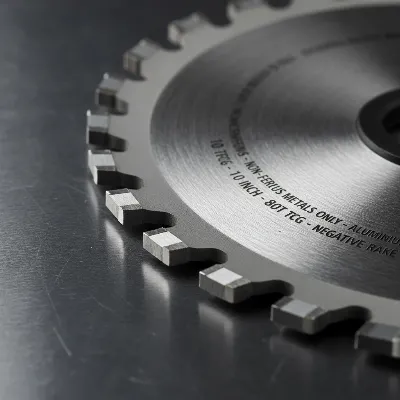 Close-up of a carbide-tipped non-ferrous metal blade with negative rake angle
Potential Risks and Limitations
While cutting aluminum with a table saw is achievable with the right precautions, it’s essential to be fully aware of the inherent risks and limitations. It is rarely the ideal solution and should be considered a last resort for occasional, simple cuts rather than a regular practice.
- Kickback: The Deadly Danger: As mentioned, kickback is the most significant hazard. When the blade grabs the aluminum, it can launch the workpiece at extreme speeds towards the operator. The hard, sharp edges of aluminum make this projectile even more dangerous than wood. Kickback can cause severe lacerations, blunt force trauma, and even fatal injuries.
- Overheating, Gumming, and Chip Welding: Aluminum’s relatively soft and ductile nature makes it prone to welding itself to the saw blade’s teeth and gullets. This “gumming up” or “chip welding” generates excessive heat, reduces cutting efficiency, leads to rough cuts, and can quickly dull or damage your expensive non-ferrous blade. Without proper lubrication and a slow feed rate, this is almost guaranteed to occur.
- Machine Wear and Damage: A table saw’s motor and bearings are not designed for the stresses of cutting metal. Even with the correct blade, the increased load and vibrations can accelerate wear on internal components, shortening the lifespan of your woodworking machine. Over time, regular aluminum cutting can degrade your saw’s precision and reliability for its primary purpose.
- Dust Hazards: Respiratory and Explosive: The fine dust generated from cutting aluminum is highly problematic. Beyond the risk of respiratory diseases like pneumoconiosis, aluminum dust is highly flammable. When mixed with air in certain concentrations, it can become explosive. This risk is compounded in a woodworking shop where fine wood dust (also highly flammable) is often present. A spark from the saw can ignite this mixture, leading to a fire or explosion.
- Suboptimal Cut Quality: Even with the best setup, a table saw typically cannot achieve the same level of precision, smoothness, and burr-free finish as dedicated metal-cutting saws (like cold saws or specialized metal chop saws). You may find yourself spending considerable time deburring and finishing edges after cutting aluminum on a table saw.
> “While a table saw can technically cut aluminum, it’s akin to using a screwdriver as a hammer. It might work, but it’s not designed for the job, and you risk damaging both the tool and your project, or worse, yourself.” – John Doe, Master Woodworker and Metal Fabricator.
Alternatives for Aluminum Cutting
Given the risks and limitations of using a wood table saw for aluminum, it’s worth considering dedicated tools that are specifically designed for this task. These alternatives offer superior safety, precision, and efficiency.
- Dedicated Cold Saws: These machines are purpose-built for cutting metal, including aluminum. They operate at much lower RPMs than table saws, reducing heat buildup and minimizing chip welding. Paired with specialized HSS (High-Speed Steel) or carbide-tipped blades, they produce very clean, burr-free cuts without the need for lubrication.
- Miter Saws with Non-Ferrous Blades: For cutting aluminum profiles, tubing, or bars to length, a miter saw equipped with a suitable non-ferrous metal blade (negative rake, high TPI, TCG) can be a good option. The controlled plunge motion and often slower RPMs make them safer than a table saw for these specific applications.
- Circular Saws with Metal Cutting Blades: For larger aluminum sheets or plates, a handheld circular saw fitted with a metal-cutting blade (often carbide-tipped) can be effective. It requires careful clamping of the workpiece and the use of a guide rail for straight cuts.
- Metal Shears: For thin aluminum sheets, manual or powered metal shears offer a very safe and efficient way to make straight cuts without generating dust or chips.
- Routers with Carbide Bits: For precise cuts and clean edges on thinner aluminum, a router with a carbide-tipped straight bit can be used, often with a clamped straightedge as a guide. This method produces less dangerous chips than a saw, but proper chip extraction is still important.
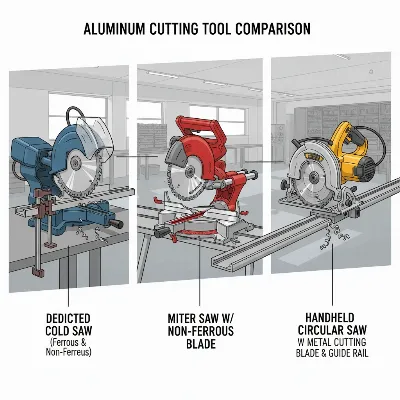 Various tools for cutting aluminum safely, including a cold saw and miter saw
An Safety When Using Table Saw
The inherent design of a table saw, optimized for wood, introduces several unique safety concerns when cutting aluminum. Recognizing and mitigating these risks is paramount for DIYers.
Understanding Kickback and Its Aluminum-Specific Dangers
Kickback, the violent ejection of the workpiece towards the operator, is amplified with aluminum. The material’s ductility and tendency to “grab” the blade mean that even minor misalignments or inconsistent feed rates can cause the blade to bind. With wood, a kickback might result in a broken board; with aluminum, the sharp, hard edges of the metal can cause severe lacerations and blunt force trauma. Furthermore, aluminum’s higher density means more kinetic energy in a kickback event.
The Problem of Chip Welding and Heat Buildup
Aluminum’s softness means it can easily melt and fuse to the blade teeth, a phenomenon called chip welding or gumming. This not only dulls the blade rapidly but also changes the effective tooth geometry, increasing friction and heat. Excessive heat can warp the aluminum workpiece, damage the blade, and even cause the saw’s motor to overheat. Proper lubrication (cutting wax, oil) is essential to create a barrier and carry away heat, preventing this dangerous buildup.
The Insidious Threat of Aluminum Dust
Beyond the immediate hazards, aluminum dust poses a long-term health and safety risk. Fine aluminum particles, when inhaled, can lead to serious respiratory issues. More critically, aluminum dust is highly combustible. When airborne in sufficient concentrations (e.g., from poor dust collection or cleaning), it can ignite with a spark, leading to a flash fire or even an explosion, especially when mixed with wood dust. Regular, thorough cleaning of the saw, dust collection system, and workspace is not just about tidiness; it’s a critical fire prevention measure.
Conclusion
Cutting aluminum with a wood table saw is a task that, while technically possible, demands an uncompromising commitment to safety and a thorough understanding of its specialized requirements. It is a procedure fraught with inherent risks, including dangerous kickback, rapid blade degradation from chip welding, potential damage to your valuable woodworking equipment, and serious health hazards from aluminum dust. For the dedicated DIYer, armed with the correct non-ferrous metal blade, comprehensive personal protective equipment (PPE), a meticulously secured workpiece, and precise cutting techniques, occasional and simple aluminum cuts can be achieved.
However, it is crucial to reiterate that a table saw is primarily designed for wood, and pushing it into metalworking territory should always be approached with extreme caution and considered a last resort. For anyone anticipating regular or complex aluminum fabrication, investing in a dedicated metal-cutting saw or utilizing alternative tools like specialized miter saws or cold saws will offer significantly greater safety, efficiency, and superior cut quality. Always prioritize your safety and the longevity of your tools. Remember, no project is worth risking your well-being.
What specific aluminum cutting challenges are you currently facing that might make a dedicated tool a better choice?
Câu Hỏi Thường Gặp
Can I use a regular wood blade to cut aluminum safely?
No, absolutely not. Using a standard wood blade to cut aluminum is extremely dangerous. Wood blades have an aggressive positive rake angle that will grab the softer aluminum, leading to violent kickback, blade damage, and potential serious injury. Always use a specialized carbide-tipped blade designed for non-ferrous metals with a negative rake angle and high tooth count.
What kind of lubrication should I use when cutting aluminum on a table saw?
You should use a cutting lubricant such as a wax stick lubricant, cutting oil, or even WD-40 applied to the blade and the cut line. This lubrication reduces friction, prevents aluminum from sticking and gumming up the blade (chip welding), dissipates heat, and helps extend the life of your blade.
Why is kickback more dangerous with aluminum than with wood?
Kickback is more dangerous with aluminum because the material’s sharp, hard edges and higher density mean that a kicked-back piece can become a far more dangerous projectile, causing severe lacerations and blunt force trauma compared to wood. Aluminum’s tendency to grab the blade also increases the likelihood and violence of kickback.
Is aluminum dust really flammable or explosive?
Yes, fine aluminum dust is highly flammable and, when airborne in sufficient concentrations, can be explosive. This risk is amplified in a woodworking environment where it can mix with wood dust, which is also combustible. Proper respiratory protection and meticulous cleanup are essential to mitigate this hazard.